


In Miami’s ultra-luxury condo market, one of the easiest mistakes to make is assuming that the largest penthouse should command the highest price per square foot.
Recent Miami penthouse sales tell a very different story.
A 5,535-square-foot penthouse at The Surf Club sold for $44 million, or $7,949 per square foot. Meanwhile, a 10,755-square-foot penthouse at Regalia sold for approximately $19.89 million, or $1,849 per square foot. The Regalia residence was nearly twice the size, yet The Surf Club penthouse achieved more than four times the price per square foot.
That is not an anomaly. It illustrates one of the defining characteristics of Miami’s trophy real estate market:
At the very top of the market, buyers are not simply purchasing square footage. They are purchasing scarcity, location, architecture, views, privacy and irreplaceability.
And those attributes do not increase proportionately with size.
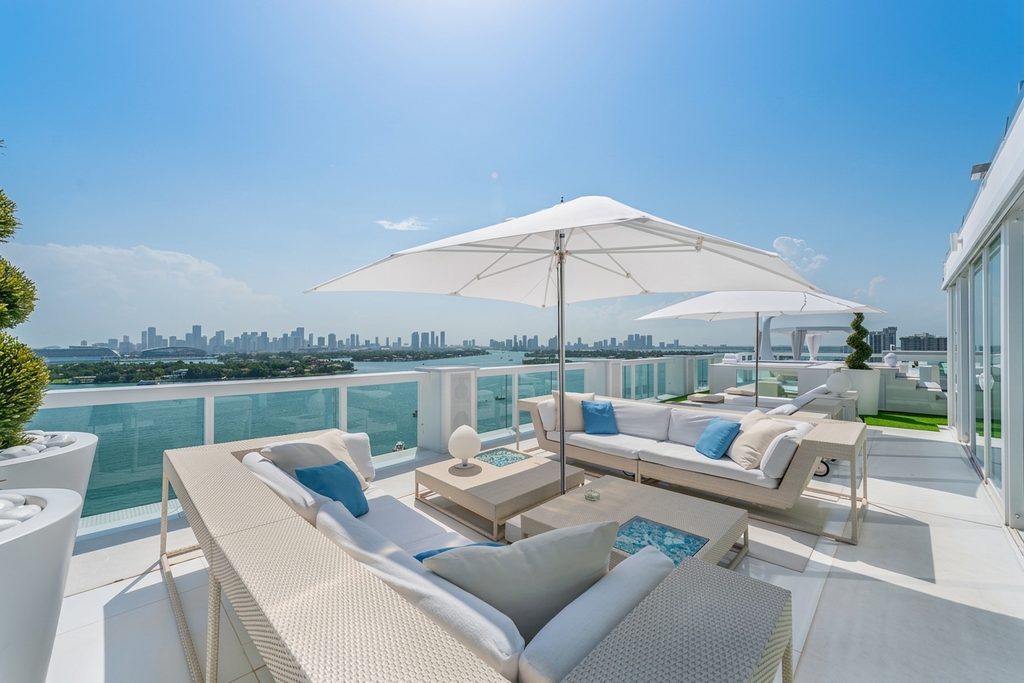
What Recent Miami Penthouse Sales Actually Show
Consider several significant penthouse transactions from Southeast Florida MLS records:
| Penthouse | Interior SF | Sale Price | Sold $/SF |
|---|---|---|---|
| Surf Club N-PH6 | 5,535 | $44,000,000 | $7,949 |
| Surf Club S-PH2 | 5,675 | $38,200,000 | $6,731 |
| Surf Club N-PH4 | 7,287 | $48,000,000 | $6,587 |
| Fisher Island PH1 | 7,000 | $37,000,000 | $5,286 |
| Eighty Seven Park PH1702 | 6,380 | $29,000,000 | $4,545 |
| Echo Brickell PH56 | 11,068 | $33,000,000 | $2,982 |
| Jade Signature PH5603 | 11,661 | $28,641,500 | $2,456 |
| ICON South Beach PH1 | 9,039 | $23,500,000 | $2,600 |
| Regalia PH43 | 10,755 | $19,888,888 | $1,849 |
Source: Southeast Florida MLS closed-sale records supplied for this analysis.
The three Surf Club transactions alone ranged from approximately $6,587 to $7,949 per square foot, while several substantially larger penthouses elsewhere traded below $3,000 per square foot.
This does not mean the larger residences were inferior homes.
It means square footage alone is a poor way to value an extraordinary penthouse.
The Penthouse Premium Is Not Linear
In conventional residential real estate, buyers often start with comparable price per square foot and adjust from there.
At the trophy level, that methodology becomes increasingly unreliable.
A buyer considering a 2,000-square-foot condo can usually find multiple reasonably similar alternatives. A buyer seeking a particular full-floor oceanfront penthouse, private rooftop, protected Atlantic exposure or residence in a building with only a handful of comparable homes may have no true substitute.
The more irreplaceable the property becomes, the less useful conventional averages become.
Miami’s penthouse market therefore behaves more like a scarcity market than a commodity market.
The difference between 5,500 and 10,000 square feet matters.
But the difference between replaceable and irreplaceable can matter much more.
1. Scarcity Can Be Worth More Than Square Footage
Consider The Surf Club.
The MLS data shows North Penthouse 6 selling for $44 million despite having 5,535 square feet of interior space. Another Surf Club penthouse, N-PH4, sold for $48 million with 7,287 square feet.
Those are extraordinary valuations.
But a buyer isn’t simply comparing those residences with other 5,000- to 7,000-square-foot condominiums.
They are buying into a very limited oceanfront environment in Surfside, with an established trophy-building reputation and a finite number of comparable residences.
The broader market supports the distinction. MIAMI Realtors reported that Surfside’s ultra-luxury condominium threshold reached $41.6 million in Q1 2026, with a $44 million Surf Club penthouse among South Florida’s largest condominium transactions that quarter.
Scarcity changes the valuation equation.
2. There Can Be a Size Penalty at the Extreme End
More square footage is generally desirable.
But there is a point where additional square footage begins narrowing the buyer pool.
The MLS data provides several fascinating examples.
Echo Brickell PH56 contained approximately 11,068 square feet and sold for $33 million, or about $2,982 per square foot. Jade Signature PH5603 measured approximately 11,661 square feet and sold for about $28.64 million, or $2,456 per square foot.
Regalia PH43, at approximately 10,755 square feet, sold for $19.89 million, or approximately $1,849 per square foot.
These are enormous residences.
But an 11,000-square-foot condominium requires a buyer who both wants that much interior space and prefers that particular building and location at that particular price.
That is a much smaller audience.
The paradox is that adding extraordinary square footage can increase total value while simultaneously reducing the value of each incremental square foot.
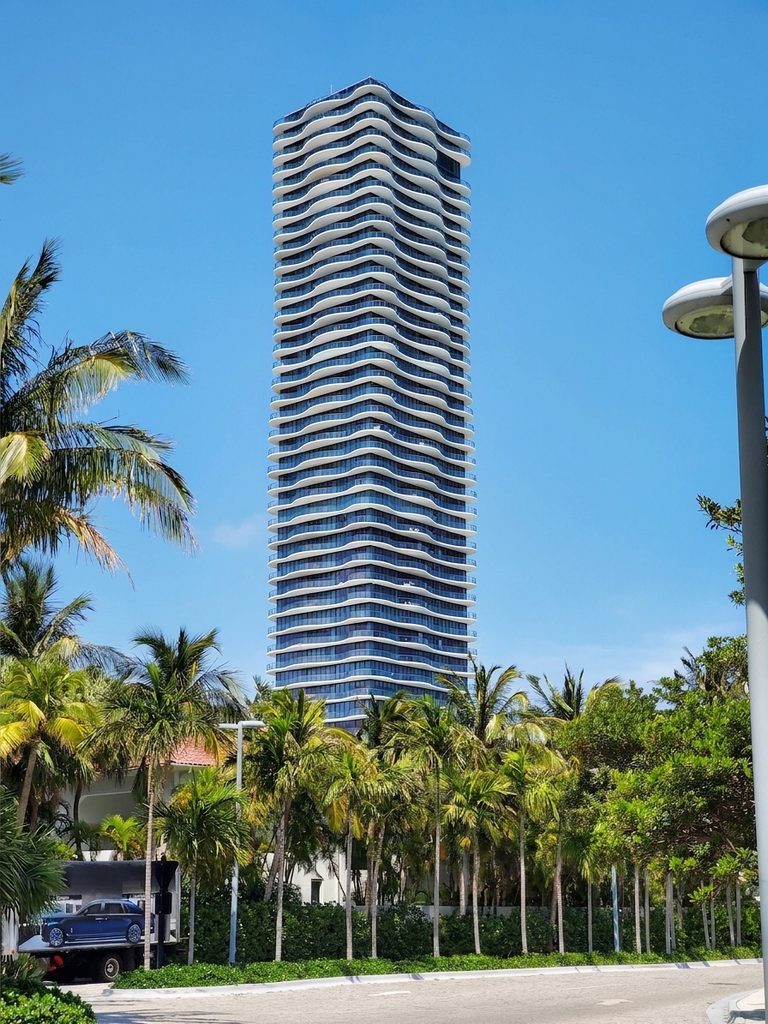
3. Oceanfront Exposure Is Not the Same as an Ocean View
This distinction matters enormously in Miami.
A residence can have spectacular ocean views without occupying an irreplaceable direct-oceanfront position.
Likewise, not every Collins Avenue building is oceanfront. Along much of Collins Avenue, odd-numbered addresses are generally on the oceanfront side, but the actual building position, setbacks, neighboring parcels and orientation still need to be evaluated individually.
For a trophy penthouse buyer, the questions become more specific:
Can the view be obstructed?
How wide is the ocean exposure?
Does the residence face directly east, or does it have multiple exposures?
Can the buyer see sunrise and sunset?
How much glass frontage does the residence have?
Does the terrace actually function as outdoor living space?
Two residences with identical interior square footage can therefore have dramatically different values.
4. Outdoor Square Footage Has Unequal Value
A 2,000-square-foot terrace isn’t automatically worth twice as much as a 1,000-square-foot terrace.
Usability matters.
A narrow wraparound balcony and a deep rooftop terrace capable of accommodating a pool, outdoor kitchen, dining area and entertaining spaces are completely different products.
Buyers should evaluate:
- depth rather than just total area;
- privacy from neighboring residences;
- wind exposure at elevation;
- covered versus uncovered areas;
- direct access from primary living spaces;
- rooftop ownership and exclusive-use rights;
- private pools and summer kitchens; and
- whether outdoor space has protected water exposure.
At this level, the terrace can become one of the residence’s defining features rather than an accessory to the interior.
5. Building Prestige Creates Its Own Multiplier
Penthouse valuation cannot be separated from the building underneath it.
Architecture, service, privacy, resident profile, density, amenities, management and historical resale performance all affect what a buyer will pay for the crown residence.
The same penthouse placed atop two different buildings can have radically different values.
This is particularly important with Miami’s branded-residence boom.
A recognized hospitality or design brand can create value, but the logo itself isn’t enough. Buyers should determine whether the brand materially improves service, scarcity and the ownership experience, and whether buyers have historically paid a premium for that distinction on resale.
A Smaller Penthouse Can Be the More Important Property
The Surf Club-versus-Regalia comparison makes this particularly clear.
Surf Club N-PH6
5,535 SF
$44 million sale
$7,949/SF
Regalia PH43
10,755 SF
$19.89 million sale
$1,849/SF
The Surf Club residence was approximately 49% smaller, yet sold for more than twice the total price and approximately 4.3 times the price per interior square foot.
That doesn’t make Regalia inexpensive or The Surf Club overpriced.
It demonstrates that they are fundamentally different luxury products.
At this level, asking “How much is it per square foot?” is only the beginning of the valuation discussion.
The more important question is:
“What can I buy that truly replaces this property?”
Sometimes the answer is very little.
Sometimes it is nothing.
That’s when the market can assign an extraordinary premium.
The Irreplaceability Premium
For sophisticated buyers, I believe this is one of the most useful ways to think about Miami’s trophy-property market.
Call it the irreplaceability premium.
A residence becomes increasingly difficult to replicate when several characteristics overlap:
Scarce location + exceptional building + protected views + extraordinary elevation + architectural distinction + usable outdoor space + privacy + limited comparable inventory.
None of those characteristics alone guarantees superior appreciation.
But when several occur in the same residence, conventional price-per-square-foot comparisons become less meaningful.
This principle extends beyond penthouses.
It helps explain why certain oceanfront condos, waterfront estates, historic properties and exceptionally positioned residences can trade far above neighborhood averages. Penthouse scarcity is one input among several that determine whether a premium survives resale. Supply scarcity and demand scarcity arrive together at the top of a building, which is why the relationship is not linear. The irreplaceability premium framework places residence scarcity alongside land, position and view permanence, and explains why the rarest residence is not always the most valuable one.
Asking Price Is Not Market Value
The active penthouse inventory provides another warning.
Current MLS asking prices include extraordinary spreads, from penthouses around or below $1,000 per square foot to trophy and preconstruction offerings exceeding $4,000, $5,000 and even $6,000 per square foot.
But asking prices are seller expectations.
Closed sales are market evidence.
That distinction becomes particularly important with penthouses because each residence can be unique enough for a seller to test an aggressive price for an extended period.
The MLS data also contains apparent inconsistencies, including two $50 million Waldorf Astoria Miami penthouse entries showing dramatically different reported square footage.
A penthouse analysis should therefore verify the residence itself before relying on an MLS-generated $/SF calculation.
What I Would Analyze Before Buying a Miami Penthouse
For a serious penthouse buyer, I would put less emphasis on finding the largest residence and more emphasis on determining what is actually scarce.
Start with the building and location. Then examine view protection, elevation, width of exposure, floor plan, ceiling heights, outdoor space, privacy, parking, service level and the number of genuinely comparable residences.
Then examine the closed sales.
Not just the asking prices.
And finally ask the question that often exposes whether the premium is justified:
If this penthouse disappears from the market tomorrow, how easily can I replace it?
If there are six acceptable alternatives, the seller has competition.
If there is one, the buyer has a decision.
If there are none, you’ve found the characteristic that drives the upper end of Miami real estate.
Everything above measures the shape of the premium inside a building. The prior question, whether the penthouse premium is real at all, is answered in Is a Miami Penthouse Worth It?, which sets out the Same-Building Test, explains why the market-wide penthouse premium reads near zero, and measures what the premium costs again at resale.
Frequently Asked Questions
Why do some Miami penthouses sell for much more per square foot than larger penthouses?
Because penthouse pricing reflects far more than interior size. Location, building prestige, direct water exposure, view protection, privacy, architecture, outdoor space and scarcity can produce substantial premiums. Recent MLS transactions show smaller trophy penthouses selling at several times the $/SF achieved by significantly larger residences.
Does a penthouse always appreciate more than a regular condo?
No. A PH designation by itself does not create investment value. A penthouse that duplicates standard floor plans or lacks exceptional views, outdoor space or scarcity may command little sustainable premium over the building’s best non-penthouse residences. In MLS sales above $5 million since January 2024, penthouses closed at a median of 15% more per square foot than regular residences in the same building, but they sold for less in 7 of 28 buildings. See the Miami penthouse premium over regular units in the same building.
Is price per square foot useful when comparing Miami penthouses?
Yes, but it should be used as a diagnostic tool rather than the final valuation method. The more unique the residence, the less reliable a simple $/SF comparison becomes.
Are larger Miami penthouses better investments?
Not necessarily. Extreme size can actually reduce the number of potential future buyers. A smaller but highly scarce oceanfront penthouse may have a deeper ultra-luxury buyer pool than an enormous residence in a less coveted building.
What makes a Miami penthouse truly irreplaceable?
There is no single feature. The strongest trophy properties usually combine several: exceptional location, protected water views, architectural significance, privacy, usable outdoor space, limited supply and a building with enduring buyer demand.
Where are Miami’s most valuable penthouses?
Miami’s trophy penthouse inventory is concentrated across Miami Beach, South of Fifth, Surfside, Bal Harbour, Sunny Isles Beach, Fisher Island, Coconut Grove, Brickell and Downtown Miami. The appropriate market depends heavily on whether the buyer prioritizes direct oceanfront living, privacy, walkability, architecture, boating access or urban lifestyle.

Buying or Selling a Miami Penthouse?
The difference between a penthouse that is merely expensive and one that is genuinely irreplaceable is rarely obvious from an MLS search.
I analyze penthouses across Miami Beach, South of Fifth, Surfside, Bal Harbour, Sunny Isles Beach, Fisher Island, Coconut Grove, Brickell and Greater Miami using the individual residence, building history and comparable closed sales, not simply the PH designation or asking price.
Explore the complete Miami Luxury Penthouse Buyer’s Guide 2026.
For current penthouse availability or a confidential valuation of a trophy residence, contact Ashton Coleman, Broker-Associate with ONE Sotheby’s International Realty.
Call/Text: 305.978.7704
Email: AColeman@onesothebysrealty.com





