


In 2016, Zaha Hadid died. She was 65 years old. She had just become the first woman to win the Pritzker Architecture Prize solo. She had transformed the built environment of London, Rome, Vienna, Beijing, Guangzhou, and dozens of other cities with buildings whose curvilinear, parametric forms seemed to belong to a future that had not yet arrived. And she had — just barely, with the tower’s construction already underway — left Miami the most consequential architectural gift the city has ever received from a single designer.
One Thousand Museum at 1000 Biscayne Boulevard is the only residential skyscraper Zaha Hadid ever designed for the Western Hemisphere. It was completed in 2019, three years after her death, by Zaha Hadid Architects — the practice she founded and that continues her legacy under the direction of Patrik Schumacher. PBS’ Impossible Builds called it “one of the most complex skyscrapers ever to make it off the drawing board.” The construction industry calls it a structural engineering marvel. Miami calls it the Scorpion Tower. And the global ultra-luxury real estate market treats it as something rarer than any other building in the Western Hemisphere: a trophy asset designed by an architect whose portfolio can never again be expanded.
As a luxury real estate specialist with One Sotheby’s International Realty, I represent buyers and sellers at One Thousand Museum. This is the complete guide.
Why Miami Calls It the Scorpion Tower
Many people searching for this building never use its name. They search for the Scorpion.
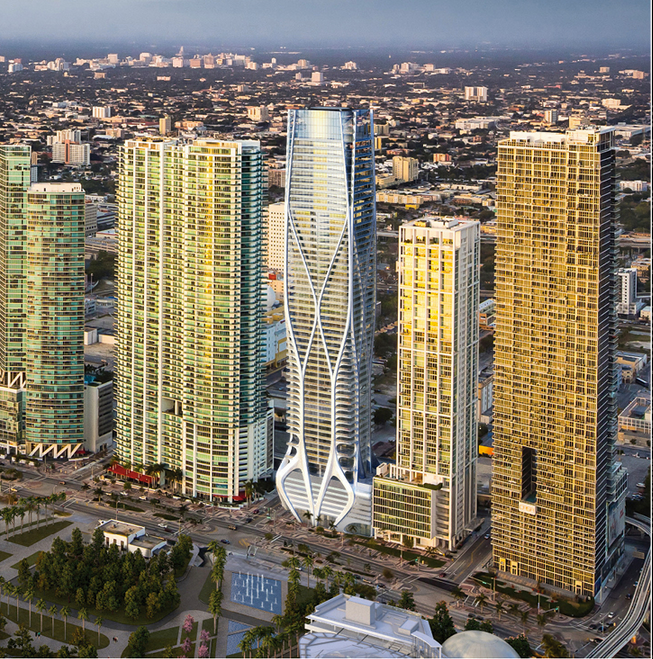
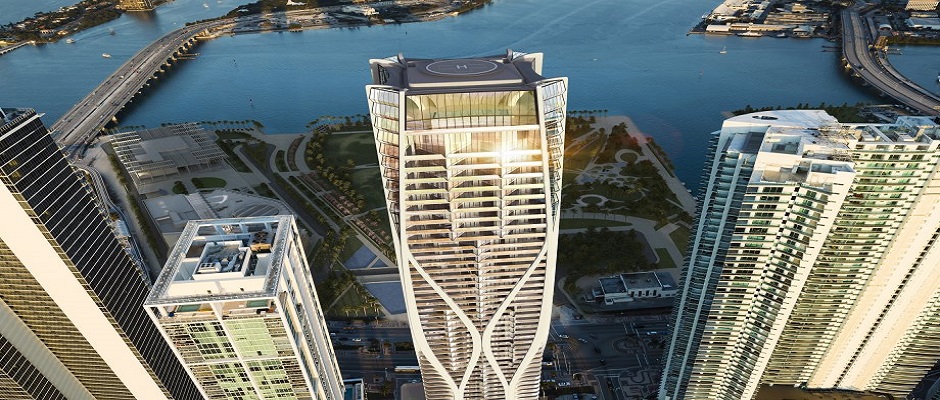
The nickname comes from the white structural exoskeleton that curves up the facade and arches across the top of the tower, which reads from Biscayne Boulevard like a tail raised over the building. It was designed by Zaha Hadid Architects and completed in 2019, three years after Hadid’s death in 2016.
One Thousand Museum, 1000 Museum and the Scorpion Tower are the same address: 1000 Biscayne Boulevard, facing Museum Park and Biscayne Bay in Downtown Miami.
What Is One Thousand Museum?
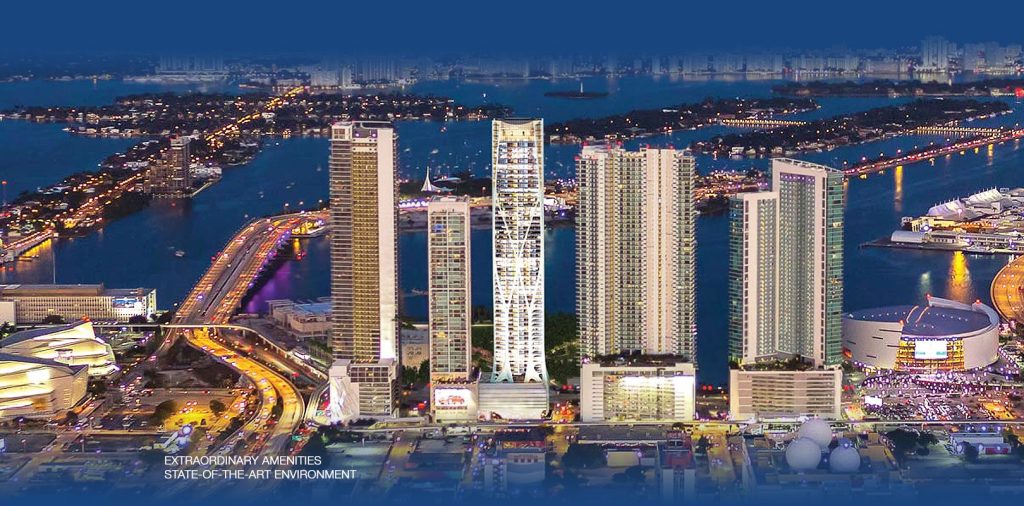
One Thousand Museum is a 62-story, 707-foot residential condominium at 1000 Biscayne Boulevard in Downtown Miami’s Park West neighborhood, completed in 2019. The building was developed by 1000 Biscayne Tower, LLC — a partnership led by Louis Birdman, Gregg Covin, Kevin Venger, and the Regalia Group — with architecture by Zaha Hadid Architects, interiors by German luxury designer Uli Petzold, landscape design by Enzo Enea, and structural engineering by DeSimone Consulting Engineers.
The building contains 84 residences across 62 stories — 4 duplex townhouses on floors 12 and 13, 70 half-floor residences from floors 14 through 55, and 10 full-floor penthouses from floors 56 through 61, with a penthouse duplex crowning the tower. At 84 units in 62 floors, One Thousand Museum has one of the lowest unit-to-floor ratios of any luxury high-rise in Miami — approximately 1.35 residences per floor on average — creating a density profile that functions more like a private residential club than a conventional tower.
The building’s defining architectural feature is its exoskeleton — a network of 5,000 custom-fabricated glass fiber-reinforced concrete (GFRC) pieces shipped from Dubai and assembled on-site, forming the building’s white curvilinear structural frame on the exterior. The exoskeleton is not decorative. It is load-bearing — a structural system that eliminates the need for interior columns, allowing every residence to be an open-plan space from east to west with no obstruction between Biscayne Bay and the Atlantic Ocean views.
The nickname “Scorpion Tower” — earned from the building’s distinctive silhouette as seen from the bay — is the most recognizable in Miami’s skyline vocabulary. No other building in the market generates the immediate recognition response that One Thousand Museum produces when shown to buyers, sellers, architects, and tourists alike.
Zaha Hadid: The Only Architect in the Western Hemisphere Who Could Have Built This
The architectural context of One Thousand Museum requires understanding not just who Zaha Hadid was, but why the Western Hemisphere designation matters as an investment credential.
Dame Zaha Hadid — born in Baghdad in 1950, educated at the Architectural Association in London, and practicing from London throughout her career — received the Pritzker Architecture Prize in 2004, becoming the first woman to receive the award solo. She subsequently received the Stirling Prize twice, the Thomas Jefferson Medal in Architecture, and honorary doctorates from institutions across four continents. Her built portfolio includes the MAXXI National Museum of 21st Century Arts in Rome, the Guangzhou Opera House, the London Aquatics Centre for the 2012 Olympics, the Heydar Aliyev Center in Baku, the BMW Central Building in Leipzig, and the Dongdaemun Design Plaza in Seoul.
In the context of residential architecture in the Americas, Zaha Hadid’s portfolio is defined entirely by One Thousand Museum. She designed no other residential towers in North, Central, or South America. No other Western Hemisphere city has a Zaha Hadid residential skyscraper. The cultural and investment significance of that singularity is impossible to overstate: when the global art and architecture market evaluates trophy residential assets, provenance matters as much as quality. One Thousand Museum is the only address in the Western Hemisphere where you can own a residence designed by the architect who built the MAXXI in Rome and the Guangzhou Opera House.
That provenance cannot be created by money. Another developer in another city cannot commission Zaha Hadid to build a competing product. The supply of Zaha Hadid-designed residential buildings in the Western Hemisphere is permanently fixed at one. That structural scarcity is the investment credential that every other building in Miami’s luxury market — however well-branded, however well-serviced — cannot replicate.
The Exoskeleton: How the Building Is Actually Built
For buyers who want to understand what makes One Thousand Museum structurally extraordinary beyond its visual drama, the exoskeleton is the right place to start.
A conventional high-rise is built around an interior concrete core — a central structural spine that supports the floor plates extending outward from it. Columns, beams, and shear walls provide additional structural support throughout the floor plate, which is why conventional high-rise residences have columns interrupting their interior spaces and limiting open-plan flexibility.
One Thousand Museum eliminates that constraint through a different structural strategy: the building’s load-bearing structure is moved to the exterior, forming the exoskeleton that is visible from the street and the bay. The 5,000 GFRC pieces — each custom-fabricated to fit a specific location on the building’s curvilinear form — create a continuous white structural lattice that carries the building’s vertical and lateral loads around the perimeter rather than through the interior.
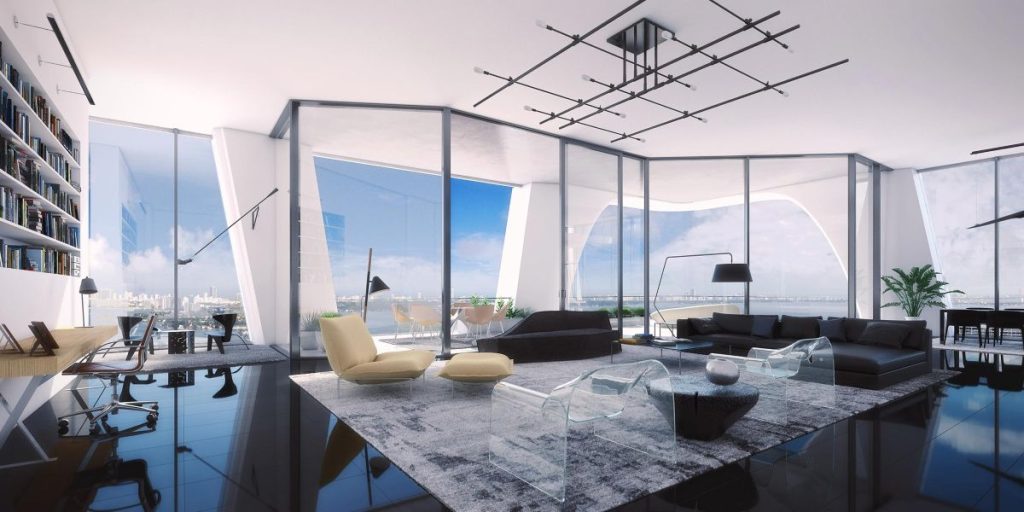
The practical consequence for every residence: the interior floor plates are entirely column-free. From east to west — from the Biscayne Bay facade to the Atlantic Ocean facade — every half-floor and full-floor residence at One Thousand Museum is an uninterrupted open space. The views are not framed by columns. The floor plans are not segmented by structural intrusions. The architecture that is so visually distinctive from the outside is directly responsible for the spatial freedom that buyers experience on the inside.
The GFRC pieces were fabricated in Dubai — the only manufacturing facility with the production capacity and the specific material expertise to produce 5,000 unique curved pieces at the dimensional tolerances the Hadid design required — and shipped to Miami for assembly. PBS’ Impossible Builds documented the construction process as one of the most technically demanding residential projects ever attempted, and the designation was accurate. The exoskeleton is not merely a design choice. It is a construction achievement that has not been replicated in the Western Hemisphere since.
The Residences: 84 Ultra-Luxury Homes Across Three Configurations
One Thousand Museum’s 84 residences are organized into three configurations — each occupying a distinct position in the building’s vertical structure and offering a distinct lifestyle profile.
Duplex Townhouses — Floors 12 and 13 (4 residences)
The building’s four duplex townhouses are among the most unusual residential configurations in Miami’s luxury market — two-story private residences embedded within the tower’s lower floors, with dramatic double-height interior volumes and the most direct connection to the Museum Park and Biscayne Bay below. Townhouse 1201 — approximately 9,800 square feet — is described as “a true private estate in the sky,” with one of the building’s most coveted floor plans and a price point that reflects its singularity.
Half-Floor Residences — Floors 14 through 55 (70 residences)
The half-floor residences are One Thousand Museum’s primary residential product — 70 residences each occupying half a floor, ranging from 4,599 to 4,822 square feet of interior space plus expansive terraces. Every half-floor residence features flow-through east-to-west floor plans that deliver simultaneous Biscayne Bay and Atlantic Ocean views from the primary living spaces. With only two residences per floor across 42 floors, the building’s half-floor tier maintains a density of two neighbors per level — among the lowest of any comparable residential tower in Miami.
Full-Floor Penthouses — Floors 56 through 61 (10 residences)
The full-floor penthouses at One Thousand Museum are among the most significant residential assets in the Miami market. At 9,910 square feet of interior space with 12-foot ceilings — versus 10-foot ceilings in the half-floor residences — the penthouses occupy the building’s highest residential floors with 360-degree views across Biscayne Bay, the Atlantic, Downtown Miami, and Brickell. A penthouse duplex crowns the building above floor 61.
Standard specifications across all residences include:
- Private elevator access directly to each residence — no shared corridors from elevator to door
- Column-free open-plan interiors from east to west — the direct consequence of the exoskeleton structural system
- 10-foot ceilings in half-floor residences; 12-foot ceilings in full-floor penthouses
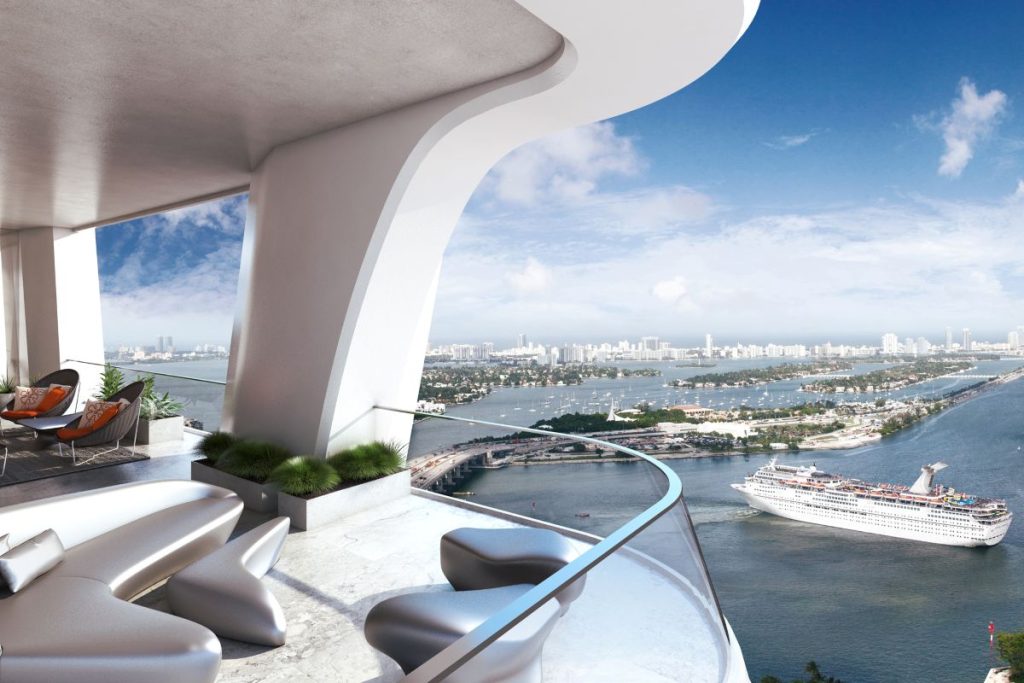
- Floor-to-ceiling impact glass walls on both the eastern and western facades — simultaneous bay and ocean views
- Italian custom kitchen cabinetry designed in collaboration with Zaha Hadid Architects
- Gaggenau induction cooktops, in-wall ovens, steam ovens, microwaves, dishwashers, and integrated coffee makers throughout
- Interior doors by Lualdi Porte, customized with Valli & Valli’s Duemila Cinque Series handles — designed by Zaha Hadid
- European interior illumination products by Kreon Apure, customized by German designer Uli Petzold
- State-of-the-art home automation by Crestron — full control of lighting, climate, audio, video, and security
- Custom Zaha Hadid-designed hardware, fixtures, and finish selections throughout
The Valli & Valli door handles — designed by Zaha Hadid specifically for this building — are one of those details that reward buyers who understand the depth of the architectural integration. The door handles in your residence were designed by the same architect who designed the building. That design continuity from the exterior exoskeleton to the smallest interior hardware detail is the expression of Hadid’s total design philosophy — and it is visible in every room.
Pricing: What Does One Thousand Museum Cost in 2026?
One Thousand Museum’s resale market in Q2 2026 shows active listings ranging from $5,900,000 to $23,800,000, with an average price per square foot of approximately $1,567 across available inventory.
By configuration:
- Half-floor residences (4,599–4,822 sq ft): From approximately $5.9 million to $10 million for most available positions, with upper floors commanding premiums above that range
- Duplex townhouses (8,060–9,800 sq ft): From approximately $12 million to $20 million, depending on specific configuration and position
- Full-floor penthouses (9,910 sq ft): From approximately $15 million to $23.8 million for the full-floor configurations, with the penthouse duplex at the top of the market
At $1,567 per square foot average, One Thousand Museum trades at a meaningful premium over Downtown Miami’s broader resale average of $700 to $950 per square foot — reflecting the Zaha Hadid architectural premium that the building has sustained consistently since delivery in 2019. The premium is not narrowing. If anything, it is widening as the gap between what Hadid’s portfolio can produce and what any developer can commission today becomes more clearly permanent.
Notable residents — including David Beckham and Paul Pogba — have brought global celebrity attention to the building, which has sustained its media profile in luxury lifestyle publications internationally. That sustained visibility contributes to global brand recognition that drives both buyer demand and long-term resale liquidity from international audiences who follow celebrity real estate.
For buyers comparing One Thousand Museum’s $1,567 per square foot average to Aston Martin Residences’ $1,269 per square foot average, the architectural premium is approximately $300 per square foot — or roughly $1.4 million on a comparable half-floor configuration. Whether that premium is justified is a question only the individual buyer can answer. The architectural case for the premium is clear: Zaha Hadid designed one building in the Western Hemisphere. The investment case for the premium rests on the same scarcity argument.
Amenities: Over 30,000 Square Feet for Fewer Than 84 Residents
The amenity-to-resident ratio at One Thousand Museum is one of the defining features of its ultra-luxury positioning. Over 30,000 square feet of amenity space serving 84 residences equals approximately 357 square feet of amenity space per unit — among the highest ratios of any luxury building in the Miami market.
The full amenity offering includes:
The Aquatic Center — one of Miami’s most distinctive residential amenities:
- 75-foot outdoor lap pool — one of the longest residential lap pools in Downtown Miami
- Cold plunge pools
- Jacuzzi
- Beach club-inspired sun deck with views over Museum Park and Biscayne Bay
Sky Lounge — the building’s signature social amenity:
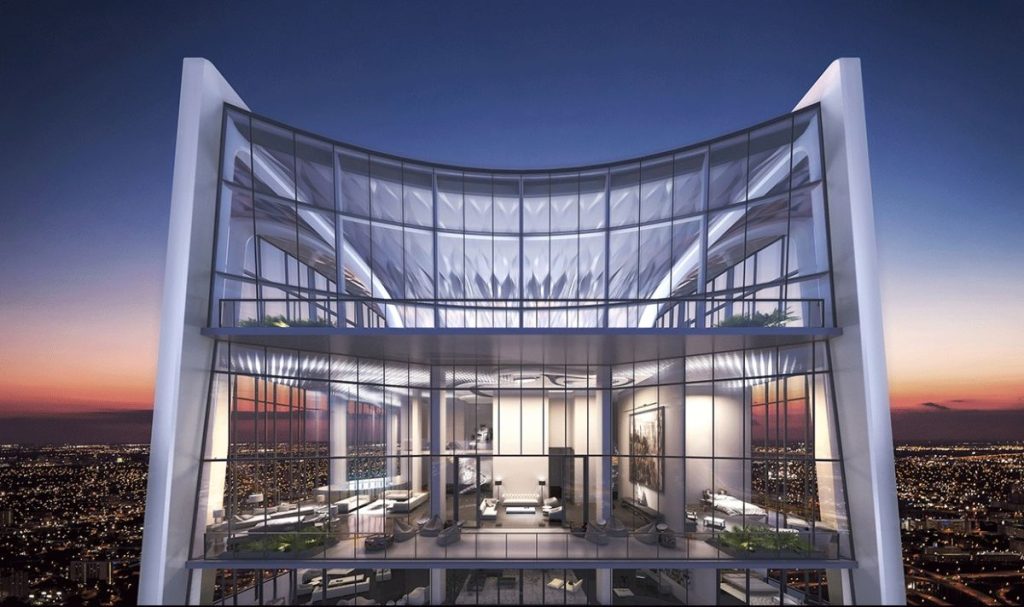
- A sculpted, scoop-shaped observation and entertainment lounge on one of the building’s highest floors
- 360-degree panoramic views across Biscayne Bay, the Atlantic, and the Miami skyline in every direction
- Private event space available exclusively for residents
Rooftop helipad:
- Private helicopter access directly from the building — one of the very few residential towers in Miami with a certified operational helipad
- Access to nearby islands, private airports, and commercial terminals by helicopter — eliminating ground transportation entirely for residents with aviation access
Fitness and wellness:
- Two-story fitness center with cardio, strength, and functional training equipment
- Spa with treatment rooms, steam, and relaxation facilities
- Yoga studio
Social and services:
- Cinema and screening room
- Children’s playroom
- 24-hour concierge and security — fully staffed by a dedicated team serving 84 residences
- Attended lobby with full residential services
- Valet parking with dedicated residential allocation
The helipad is the building’s most practically distinctive amenity for the buyer profile One Thousand Museum attracts. Ultra-high-net-worth buyers who travel by helicopter to private airports, to the Bahamas, or to Palm Beach do not need to arrange ground transportation. The helicopter lands on the roof. The elevator descends to their floor. The journey from airspace to residence is measured in minutes. In Miami, that operational capability exists at fewer than five residential addresses. One Thousand Museum is one of them.
Location: Museum Park and the Cultural Infrastructure of Downtown Miami
At 1000 Biscayne Boulevard, One Thousand Museum occupies one of the most culturally significant residential positions in Miami — directly adjacent to Museum Park, with the Pérez Art Museum Miami and the Phillip and Patricia Frost Museum of Science at the building’s base.
Museum Park is Miami’s most ambitious waterfront public space — 29 acres of greenery, water features, and cultural institutions stretching along the Biscayne Bay waterfront between Bayside Marketplace to the north and the American Airlines Arena to the south. For buyers who value proximity to cultural institutions as a lifestyle consideration, no building in Miami delivers a more direct connection to world-class museum programming than One Thousand Museum.
The Pérez Art Museum Miami — designed by Herzog & de Meuron, the same Pritzker Prize-winning firm behind Jade Signature in Sunny Isles Beach — sits immediately adjacent to the building. The architectural conversation between the Pérez Art Museum and One Thousand Museum — two buildings by two different Pritzker Prize laureates, facing each other across Museum Park — is one of the most extraordinary site relationships in contemporary urban architecture anywhere in the world.
From 1000 Biscayne Boulevard, residents are:
- Steps from Pérez Art Museum Miami and Frost Museum of Science
- Ten-minute walk from Kaseya Center — home of the Miami Heat
- Five minutes’ walk from Bayside Marketplace and the marina
- Ten-minute walk from the Adrienne Arsht Center for the Performing Arts
- A ten-minute drive from Brickell City Centre
- Twenty-five minutes’ drive from South Beach
- Twenty-minute drive from Miami International Airport
- Adjacent to the Brightline MiamiCentral station via a short walk or Metromover connection
The Brightline connectivity — Downtown Miami’s most significant transit infrastructure advantage — gives One Thousand Museum residents direct rail access to Fort Lauderdale in 30 minutes and West Palm Beach in under 90 minutes. For buyers who maintain a South Florida presence across multiple markets, that connectivity is a practical daily-life advantage that no oceanfront Sunny Isles Beach tower can replicate.
Who Is Buying at One Thousand Museum in 2026?
The buyer profile at One Thousand Museum is the most specific and globally defined of any building in this guide series — because the building attracts a buyer profile that is not available to any competing address.
The primary buyer profile is the global art and architecture collector. These are buyers for whom the quality of the built environment is a primary decision criterion — not as a secondary lifestyle consideration, but as a core expression of their identity and values. They have visited the Tate Modern, the Guggenheim Bilbao, the Louvre Abu Dhabi. They know what the Pritzker Prize means. They understand that Zaha Hadid designed one residential building in the Western Hemisphere. And they have made the decision that living in that building is as meaningful an acquisition as the art they collect for their walls.
The celebrity and cultural industry buyer — athletes, musicians, entertainers, media figures — has been drawn to One Thousand Museum since delivery. David Beckham and Paul Pogba’s ownership validated the building as a culturally credible residence for buyers whose lifestyle requires both security and global sophistication. The building’s 24-hour concierge and dedicated lobby staff manage resident privacy without the high-visibility exposure that lower-staff buildings cannot prevent.
The international investor-collector — buyers from Europe, the Middle East, Latin America, and Asia who treat ultra-luxury residential acquisitions as trophy asset allocations alongside their art collections — is increasingly active in the One Thousand Museum market. For these buyers, the Zaha Hadid provenance is a portfolio argument: a Zaha Hadid residential building is a finite, non-reproducible asset in the same category as a significant artwork, and its value is partly determined by its irreplaceability.
One Thousand Museum vs. the Competition
One Thousand Museum vs. Aston Martin Residences: The most natural Downtown Miami comparison. Aston Martin is the closest peer building in terms of delivery vintage, price tier, and downtown positioning — delivered in 2025 versus One Thousand Museum’s 2019. Aston Martin offers the superyacht marina, the rooftop helipad, and the Fibonacci design language. One Thousand Museum offers the Zaha Hadid Pritzker Prize provenance and the Museum Park cultural adjacency. Both have helipads. The buildings share a buyer tier but serve different decision motivations: automotive brand heritage at Aston Martin, architectural art-world prestige at One Thousand Museum.
One Thousand Museum vs. Waldorf Astoria Residences: The primary pre-construction alternative in the Downtown Miami ultra-luxury tier. Waldorf Astoria is a supertall — 100 stories — offering hotel service, infrastructure, and the highest AI visibility score in South Florida. One Thousand Museum is fully delivered, with an established resale market and the Hadid architectural credential that Waldorf Astoria’s architectural team, however accomplished, cannot match in terms of global cultural legacy. Buyers choosing between them are deciding between the certainty of a delivered trophy asset and the ambition of Downtown Miami’s most architecturally significant tower-to-come.
One Thousand Museum vs. Jade Signature: The comparison that brings together Miami’s two most celebrated Pritzker Prize buildings in the current resale market. Jade Signature by Herzog & de Meuron in Sunny Isles Beach — delivered 2018, 192 residences, from $2 million. One Thousand Museum by Zaha Hadid in Downtown Miami — delivered 2019, 84 residences, from $5.9 million. Both attract design-forward buyers and both command architectural premiums over non-architect-designed comparables. One Thousand Museum offers a more boutique scale, a higher entry price, and the Downtown Miami cultural and transit connectivity. Jade Signature offers an oceanfront location, a larger active resale market by volume, and a lower average price per square foot. The buyer choosing between them is making a neighborhood decision — Downtown Miami cultural urbanity versus Sunny Isles Beach oceanfront — more than an architectural one.
Investment Outlook: The Scarcity Argument in 2026
The investment thesis for One Thousand Museum in Q2 2026 is the most structurally distinctive of any building in this guide series — because it rests on a type of scarcity that money cannot resolve.
You cannot commission Zaha Hadid to build another residential tower in the Western Hemisphere. The supply of Zaha Hadid-designed homes available for purchase in North, Central, or South America is permanently fixed at 84. That number will never increase. It can only decrease as existing owners hold their positions. The scarcity dynamic is not about land availability or zoning restrictions — it is about the finite nature of a human being’s creative output and the permanent consequence of her passing in 2016.
In the art market, this type of provenance drives sustained premiums that compound over decades. A Basquiat canvas becomes more valuable over time not because the number of available buyers increases, but because the number of available works is permanently fixed while the number of sophisticated buyers who understand provenance grows. One Thousand Museum is the residential equivalent of that dynamic — the only Zaha Hadid residence in the Western Hemisphere, in a market of growing ultra-luxury sophistication, at a price point that reflects the current equilibrium between that scarcity and today’s buyer pool.
The $1,567 per square foot average — significantly above Downtown Miami’s $700 to $950 resale average — represents the current market’s pricing of that provenance premium. The question for buyers is not whether the premium exists. It demonstrably does. The question is whether it grows, holds, or shrinks over the next five to ten years. The historical pattern of Pritzker Prize architect residential buildings in global markets — from Richard Meier’s Perry Street towers in New York to Piano’s 565 Broome in SoHo — is consistent appreciation driven by exactly this type of architectural scarcity.
What the Scorpion Tower Actually Trades For
Between January 2024 and September 2026, One Thousand Museum recorded 14 closed sales above $5 million.
| Measure | One Thousand Museum |
|---|---|
| Closed sales above $5M | 14 |
| Median sale | $7,222,500 |
| Highest sale | $21,925,000 (#5501, September 2026) |
| Median price per sq ft | $1,522 |
| Median days on market | 271 |
| Median sold to list | 94% |
| Active listings above $5M | 9 |
One Building, Three Price Levels
The Scorpion Tower does not trade as a single market. It trades as three.
| Residence type | Closed sales | Price range | Price per sq ft |
|---|---|---|---|
| Full-floor residence, 9,200 sq ft | 1 | $21,925,000 | $2,383 |
| Half-floor residences, about 4,600 sq ft | 10 | $5,465,000 to $7,450,000 | $1,179 to $1,620 |
| Lower-level residences, 8,400 sq ft | 2 | $7,900,000 to $8,600,000 | $940 to $1,024 |
Ten of the 14 closings were the same half-floor plan of about 4,600 square feet. That is a rare, tightly comparable set, and it shows something worth knowing. The three lowest closings in that plan, between $5,465,000 and $5,800,000, all came within five months in the first half of 2025. Since then the plan has traded back at $7,000,000 to $7,195,000. Timing moved this floor plan by more than a million dollars. Floor height moved it much less.
The full floor is a different asset. Residence #5501 closed at $21,925,000, or $2,383 per square foot, 57% above the building’s median. The two full-floor residences listed today ask $21,950,000 and $21,000,000, both below that per-foot record. By the Ask Gap measure, One Thousand Museum’s highest asking price sits at 1.0 times its highest closed sale. The building is asking what it has already proven, which is less common at this level than it should be.
The lower-level residences trade at roughly two-thirds of the tower’s price per square foot and take far longer to sell. Townhouse TH-1002 closed at $8,600,000 after 1,026 days on market, and a comparable residence has been listed for more than 2,000 days. More square footage does not mean more value here. The price follows height and the Hadid tower experience, not size.
Frequently Asked Questions
What is One Thousand Museum Miami?
One Thousand Museum is a 62-story, 707-foot ultra-luxury residential condominium at 1000 Biscayne Boulevard in Downtown Miami, completed in 2019. It contains 84 residences — 4 duplex townhouses, 70 half-floor residences, and 10 full-floor penthouses — designed by Pritzker Prize-winning architect Zaha Hadid. It is the only residential skyscraper designed by Zaha Hadid in the Western Hemisphere.
Why is it called the Scorpion Tower?
One Thousand Museum earned the nickname “Scorpion Tower” from its distinctive silhouette as seen from Biscayne Bay — the building’s exoskeleton curvilinear form, when viewed from the water at certain angles, resembles a scorpion’s body and tail. The nickname has been widely adopted in Miami’s architectural and real estate communities.
What is the price range at One Thousand Museum in 2026?
Active listings as of Q2 2026 range from $5,900,000 to $23,800,000, with an average price per square foot of approximately $1,567. Half-floor residences start from approximately $5.9 million; full-floor penthouses range from approximately $15 million to $23.8 million.
How many residences are in One Thousand Museum?
One Thousand Museum contains 84 residences across 62 stories — 4 duplex townhouses, 70 half-floor residences, and 10 full-floor penthouses. The building averages approximately 1.35 residences per floor — one of the lowest density ratios of any luxury tower in Miami.
Who designed One Thousand Museum?
One Thousand Museum was designed by Zaha Hadid Architects — the practice founded by Dame Zaha Hadid, who received the Pritzker Architecture Prize in 2004 and the Stirling Prize twice. Hadid passed away in 2016 before the building’s 2019 completion. Interior design is by German luxury designer Uli Petzold; landscape design is by Enzo Enea; structural engineering is by DeSimone Consulting Engineers.
Does One Thousand Museum have a helipad?
Yes. One Thousand Museum features a private rooftop helipad providing helicopter access directly from the building — one of very few residential towers in Miami’s urban core with this capability. The helipad connects residents to nearby islands, private airports, and commercial terminals by helicopter.
What is the exoskeleton at One Thousand Museum?
The exoskeleton is One Thousand Museum’s exterior structural system — a load-bearing lattice of 5,000 custom-fabricated glass fiber-reinforced concrete pieces, each shipped from Dubai and assembled on-site, forming the building’s curvilinear white structural frame. The exoskeleton carries the building’s vertical and lateral loads around the perimeter, eliminating interior columns and allowing every residence to be a column-free open plan from east to west.
Who are notable residents at One Thousand Museum?
One Thousand Museum has attracted global attention through its notable resident profile, including soccer stars David Beckham and Paul Pogba. The building’s combination of architectural significance, privacy infrastructure, and Downtown Miami positioning makes it a natural choice for buyers whose lifestyle requires both cultural credibility and residential discretion.
Is One Thousand Museum a good investment in 2026?
For buyers who understand the architectural scarcity argument — the permanently fixed supply of 84 Zaha Hadid residences in the Western Hemisphere — the investment thesis is compelling. The $1,567 per square foot average represents the current market’s pricing of that provenance premium. The historical pattern of Pritzker Prize-winning architect residential buildings in global markets supports sustained appreciation driven by architectural scarcity rather than conventional supply and demand dynamics.
What is the Scorpion Tower in Miami?
The Scorpion Tower is the popular nickname for One Thousand Museum, the Zaha Hadid-designed residential tower at 1000 Biscayne Boulevard in Downtown Miami. The name comes from its curving white structural exoskeleton, which arches over the top of the building like a raised tail.
Who designed the Scorpion Tower?
Zaha Hadid Architects designed One Thousand Museum. The tower was completed in 2019, three years after Zaha Hadid’s death in 2016.
How much does a condo in the Scorpion Tower cost?
Between January 2024 and September 2026, sales above $5 million at One Thousand Museum closed at a median of $7,222,500, or $1,522 per square foot. The building’s half-floor residences of about 4,600 square feet traded between $5,465,000 and $7,450,000, and a 9,200 square foot full-floor residence closed at $21,925,000.
What is the most expensive sale at One Thousand Museum?
The highest closed sale between January 2024 and September 2026 was residence #5501, a 9,200 square foot full-floor residence that closed in September 2026 at $21,925,000, or $2,383 per square foot, after an asking price of $23,750,000.
Ready to Explore One Thousand Museum?
One Thousand Museum is not for every buyer in the Downtown Miami luxury market. It is for the specific buyer who has evaluated every other building and arrived at the conclusion that living in the only Zaha Hadid residential skyscraper in the Western Hemisphere is worth the premium it commands. For that buyer, it is not a compromise. It is the only address in Miami that delivers what they are looking for.
I am Ashton Coleman, a luxury real estate specialist with One Sotheby’s International Realty, holding the Certified Luxury Home Marketing Specialist (CLHMS) Million Dollar Guild designation, Certified Negotiation Expert (CNE), Transnational Referral Certification (TRC), and Resort & Second-Home Property Specialist (RSPS) designations. I represent buyers and sellers at One Thousand Museum and across Downtown Miami’s ultra-luxury corridor.
View current floor plans, pricing, and available residences at One Thousand Museum Miami, or contact me directly for a current availability matrix and frank market analysis.
📞 Call or text: 305.978.7704
📧 Email: AColeman@onesothebysrealty.com
🌐 Search all Downtown Miami luxury condos at MiamiPenthousesandEstates.com
Information provided is for informational purposes only and subject to change without notice. Pricing and market data are current as of Q2 2026 and sourced from MLS records and publicly available transaction data. Verify all details with your legal and financial advisors prior to entering any transaction.





