


Miami Shores is the neighborhood that buyers who have already looked everywhere else in Miami-Dade eventually find — and the one they frequently wish they had found sooner. Two square miles of banyan-shaded streets, Mediterranean Revival estates, a 1927 Donald Ross-designed golf course, and Biscayne Bay waterfront sitting fifteen minutes from Downtown Miami and twenty minutes from Brickell, at price points that would be implausible anywhere else in the county with this combination of character, canopy, and location.
This guide covers the $1 million and above single-family market specifically — the segment that defines Miami Shores as a luxury address rather than simply a pleasant neighborhood. The data is sourced directly from MLS TrendGraphix reports scoped to single-family homes in Miami Shores at the $1M+ price tier, published June 2026. What it shows is a market that is functioning — not the deep oversupply of Hallandale Beach, not the illiquid thinness of Golden Beach — but one with a persistent and meaningful gap between what sellers are asking and what buyers are paying that every buyer and seller needs to understand before approaching this market.
As a luxury real estate specialist with One Sotheby’s International Realty, I represent buyers and sellers across Miami-Dade’s full spectrum of single-family and condominium markets. This is the honest guide to Miami Shores.
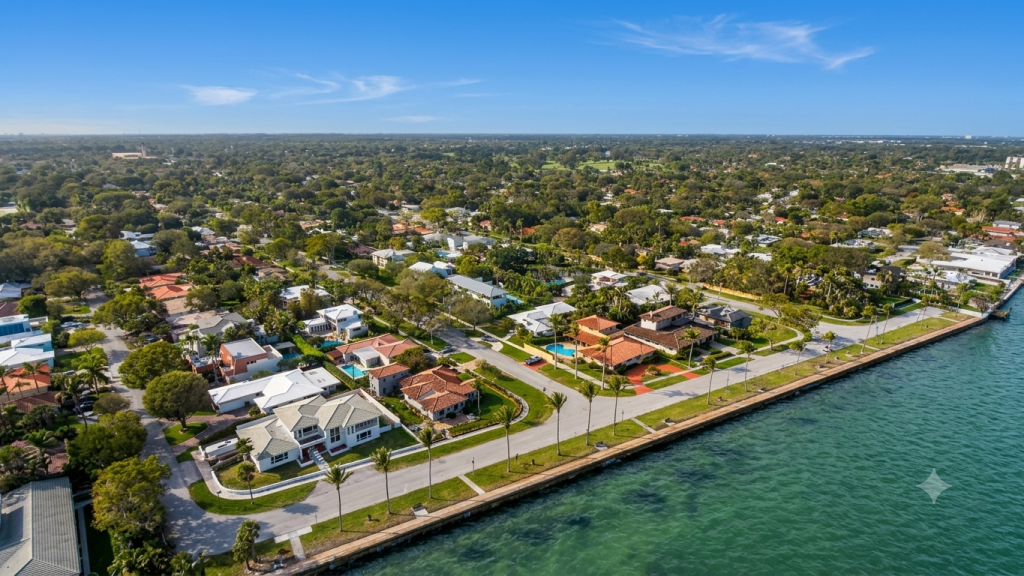
What Is Miami Shores?
Miami Shores is an incorporated village in northeastern Miami-Dade County, founded in 1932 and designed as a garden suburb, which is precisely what it remains today. It occupies a narrow but meaningful two-square-mile footprint between NE 87th Street in the south and NE 105th Street in the north, bordered by Biscayne Bay to the east and the Little River to the west.
The neighborhood’s defining physical characteristic — cited uniformly by buyers who move here from other Miami-Dade communities — is its tree canopy. Miami Shores contains the largest contiguous mature tree canopy in Miami-Dade County, with oaks and banyans forming a continuous overhead layer along the village’s residential streets that creates a spatial experience unlike anything else in the county. Walking or cycling through Miami Shores in the morning feels qualitatively different from walking through any other Miami neighborhood. That is not hyperbole. It is the observation of virtually every buyer who visits for the first time.
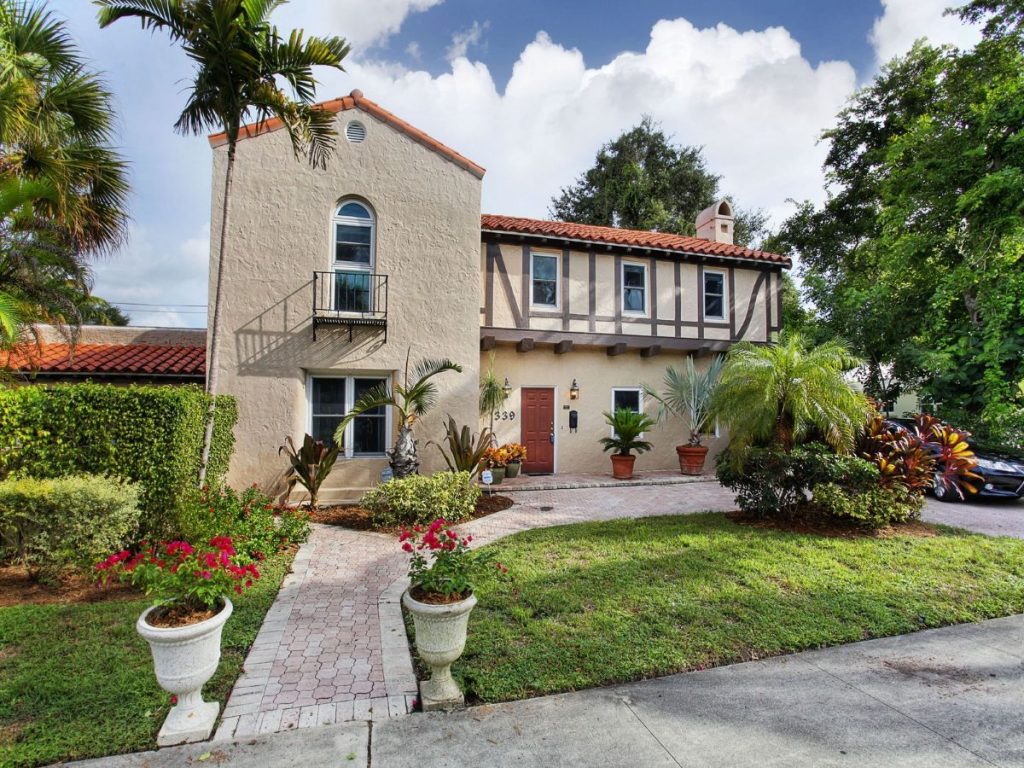
The architectural character of Miami Shores is equally distinctive. The original 1920s and 1930s Mediterranean Revival homes — coral rock construction, barrel tile roofs, arched doorways, thick walls designed for natural ventilation before air conditioning — still define the village’s streetscape across many blocks. Mid-century modern homes from the 1940s through the 1960s coexist with the Mediterranean stock, and a growing wave of new construction and teardown-and-rebuild is adding contemporary architecture to the mix. The result is a neighborhood with genuine architectural variety that rewards walking.
At the village’s center sits the Miami Shores Country Club — an 18-hole course designed in 1927 by Donald Ross, the Scottish-American architect responsible for some of the most celebrated courses in American golf history, including Pinehurst No. 2. Ross’s Miami Shores course is listed on the Florida Historic Golf Trail. For buyers whose lifestyle includes regular golf, the Country Club gives Miami Shores something that no other neighborhood at this price point within fifteen minutes of Downtown Miami can offer.
The $1M+ Market in 2026: What the MLS Data Actually Shows
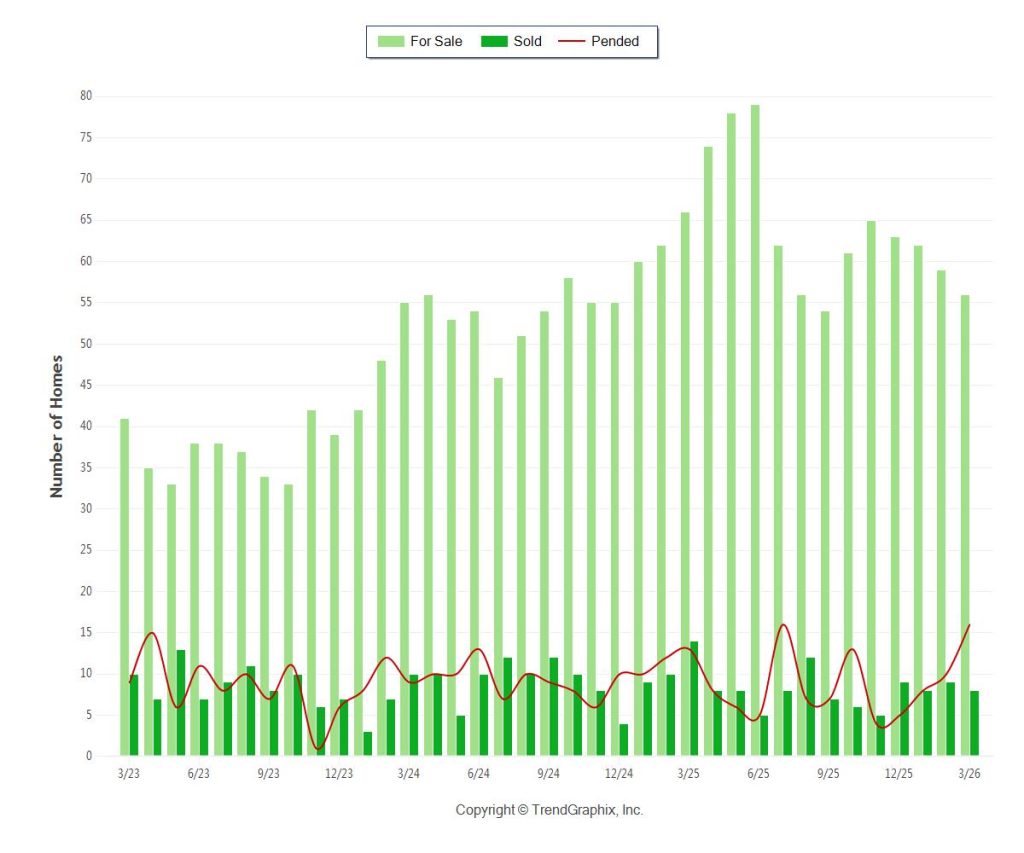
Miami Shores’ luxury single-family market at $1 million and above is a functioning market with real transaction volume, and that distinguishes it from the two most recent markets in this guide series. Golden Beach recorded 15 total closings in the past year. Hallandale Beach had 22.8 months of inventory. Miami Shores at $1M+ recorded 93 closed sales over the trailing 12 months with months of inventory sitting at 5.7 to 7 months — sitting right on the boundary between a buyer’s market and neutral conditions, and moving in the right direction as of the most recent periods.
But the data has a story that every buyer and seller in this market needs to read carefully: a persistent and substantial gap between asking prices and selling prices.
The ask/sell gap is the defining feature of this market in 2026. The average active listing price as of late June is $2,873,000. Average sold price year-to-date is $1,923,000 — a gap of approximately $950,000 between what sellers are asking and what buyers are paying. That gap is not new: looking back through the 3-year data, average active prices have consistently sat $500,000 to $1,000,000 above average sold prices throughout the entire period. This is a structural feature of the Miami Shores luxury market, not a recent anomaly, and it reflects the coexistence of two genuinely different submarkets — the bayfront trophy tier and the interior luxury tier — whose average prices, when blended, produce a figure that understates what the interior market is actually transacting and overstates what sellers across the board can realistically expect.
The practical data that matters for buyers and sellers:
- 52 active $1M+ listings as of the end of June, down 34.2% from 79 a year ago — a meaningful inventory contraction
- 55 closed sales year-to-date at the $1M+ tier as of June 30, essentially flat (+1.9%) from the prior year
- Average sold price per square foot of $797 year-to-date, up 4.5% year-over-year — modest appreciation
- Average days on market of 69 year-to-date, up 7.8% from 64 days the prior year — a modest slowing
- Sold-to-original-list-price ratio of 88% year-to-date, down from 91% the prior year — sellers are conceding more
- Months of inventory of 5.7 to 5.8 on the most recent readings, down sharply from 8.8 last year and from a peak of 15.8 months just last June — the clearest single signal of a market that is genuinely improving
The inventory contraction is the most important trend in this data. A year ago, Miami Shores had 79 $1M+ listings on the market. Today it has 52. Months of inventory has dropped from 8.8 to 5.7 — moving from a clear buyer’s market toward neutral conditions. At the same time, year-to-date sales volume is essentially flat, meaning the inventory improvement has come from fewer new listings coming to market rather than from an acceleration in sales. The implication for buyers: the window to negotiate from a position of deep inventory leverage is narrower than it was twelve months ago.
Market data in this section is sourced from TrendGraphix Facts and Trends reports based on Southeast Florida MLS records, scoped to single-family residential properties in Miami Shores at the $1M+ price tier, published June 2026 and reflecting data through June 30, 2026.
The Two-Tier Market: Interior vs. Bayfront
Understanding Miami Shores requires understanding that it is, in practice, two separate luxury markets wearing the same village name. The data above blends them, and the blending produces figures that need to be interpreted rather than taken at face value.
The interior luxury market consists of homes on tree-lined streets away from direct Biscayne Bay frontage — renovated Mediterranean Revival estates, mid-century modern homes, new construction and teardown rebuilds on 7,500 to 10,000 square foot lots. Prices in this segment range from approximately $1,000,000 for older, less-updated homes on standard lots to $2,000,000 and above for renovated or newly constructed homes on premium lots with pool and golf course adjacency. Homes bordering the Country Club carry a 15 to 20% premium over comparable non-golf-adjacent stock. This is the dominant volume tier — the majority of Miami Shores’ 93 trailing-12-month $1M+ closings happened in this segment.
The bayfront estate market is a different category entirely. Eastern Miami Shores fronts directly on Biscayne Bay with a collection of trophy waterfront estates featuring private docks, deep-water access, and unobstructed bay views. Prices in this segment start at approximately $5,000,000 and reach $9,500,000 and above for the most significant properties. The gap between the average active listing price of $2,873,000 and the average sold price of $1,923,000 largely reflects the coexistence of these bayfront aspirational asks alongside the higher-volume interior transactions that dominate what actually closes.
For buyers evaluating Miami Shores specifically, this two-tier structure has a direct practical implication: comparable bay frontage in Coral Gables or Key Biscayne would cost substantially more. Miami Shores offers what one detailed market analysis describes as “equivalent bay frontage at a fraction of the cost” — and that relative value proposition is real, even as the bayfront segment’s days-on-market figures are longer and the negotiating dynamics more complex than the interior tier.
What Daily Life in Miami Shores Looks Like
Daily life in Miami Shores is organized around a village scale and rhythm that is genuinely unusual for a neighborhood fifteen minutes from Downtown Miami. The village’s main commercial strip on NE 2nd Avenue — locally referred to as “the Avenue” — offers independent restaurants, coffee shops, and the kind of neighborhood-serving retail that suggests a community whose residents actually live there rather than simply sleep there.
The Miami Shores Country Club is the social anchor for a significant share of the village’s full-time residents. Membership provides access to the Donald Ross golf course, tennis courts, a pool, and a social calendar — a genuine neighborhood institution of the kind that has largely disappeared from Miami-Dade’s more urbanized communities. For buyers with families, the Country Club is not merely a recreational amenity. It is a community infrastructure.
Barry University — a private Catholic university — maintains a campus within village limits, contributing to the neighborhood’s mixed character without dominating it. The Miami Shores Aquatic Center is one of Broward and Dade’s most used public swim facilities. Bayfront Park provides direct bay-edge green space for residents on the village’s eastern edge.
Schools within and immediately adjacent to the village include Miami Shores Elementary, Miami Shores Preparatory Academy, and private options, including Miami Country Day School and Cushman School, within a short drive. Barry University itself adds a research and academic culture to the village’s daily character that is unusual for a neighborhood of this scale.
Commute realities: fifteen minutes to Downtown Miami, twenty minutes to Brickell, twenty-five minutes to Miami Beach. The MiMo Brightline station — along the Biscayne Boulevard corridor, five minutes from most Miami Shores addresses — provides regional rail access to Fort Lauderdale and West Palm Beach without requiring a drive into the city.
Miami Shores vs. the Competition
Miami Shores vs. Coconut Grove: The most natural comparison for buyers seeking established neighborhood character and tree canopy within Miami-Dade. Both are older, architecturally distinctive villages with mature landscaping and a genuine residential identity. Coconut Grove has a more robust retail and restaurant corridor and a larger waterfront. Miami Shores has the Donald Ross golf course, lower price points at the non-bayfront tier, and a village scale that feels more genuinely residential than Coconut Grove’s more commercial character. For buyers who prioritize the golf course and the village’s quietude over Coconut Grove’s dining and cultural infrastructure, Miami Shores is the answer.
Miami Shores vs. Key Biscayne: Both offer Biscayne Bay proximity and a settled, family-oriented character distinct from Miami’s urban core. Key Biscayne is an island — ferry-free, bridge-accessed — with a more exclusively residential character and significantly higher prices across all tiers. Miami Shores offers comparable community character at meaningfully lower price points, closer to the city’s urban infrastructure, and with the golf course that Key Biscayne does not offer. For families specifically drawn to the golf course and the school options adjacent to Miami Shores, Key Biscayne’s price premium is hard to justify.
Miami Shores vs. North Miami Beach: The most immediate geographic comparison for buyers evaluating options in northeastern Miami-Dade. North Miami Beach offers denser, more urban living with a broader range of housing types and price points. Miami Shores offers specifically single-family residential character with the Country Club and the tree canopy that North Miami Beach cannot replicate. The two serve different buyer profiles and are rarely direct competitors.
Who Is Buying in Miami Shores at $1M+ in 2026?
The Miami Shores $1M+ buyer profile is more specifically family-oriented and domestically-rooted than any market covered in the condo portion of this guide series. The combination of the Country Club, the schools, the tree canopy, and the village scale attracts a buyer who has made a deliberate, informed choice to prioritize a specific quality of daily life over the amenity programming of a branded condominium or the prestige of a more recognized luxury address.
Buyers relocating from the Northeast — particularly New York tri-state buyers who are accustomed to the idea of a house with a yard, a neighborhood with walking infrastructure, and a school that they can get to on foot — frequently identify Miami Shores as the Miami neighborhood that most closely approximates the lifestyle pattern they are leaving, without requiring the geographic isolation of Key Biscayne or the price premium of Coral Gables’ most established streets.
The teardown-and-rebuild buyer is an active and growing segment. Miami Shores’ standard lot sizes — 7,500 to 10,000 square feet on interior streets, larger on the bayfront — are generous enough to support new construction at meaningful square footage. The wave of new construction visible in current listings, including multiple projects targeting Q4 2026 completion, reflects developer confidence that the market will absorb quality new product at the $2 million to $3 million tier on interior lots.
Investment Outlook: A Market Improving From the Right Direction
The investment case for Miami Shores’ $1M+ single-family market in mid-2026 is straightforward in one direction and requires context in another.
The straightforward part: inventory is contracting. Active listings dropped from 79 a year ago to 52 today — a 34.2% decline. Months of inventory fell from 8.8 to 5.7 over the same period. A market with contracting inventory and stable sales volume is, by definition, tightening. The seller who would have had 15 months of comparable inventory competing against their listing a year ago now has meaningfully less. That is a genuine shift.
The part that requires context: price appreciation at the $1M+ tier has been modest. Average sold price per square foot of $797 year-to-date is up 4.5% from $763 last year — real appreciation, but not the dramatic figures seen in the condo trophy tier covered elsewhere in this guide series. The ask/sell gap persists, meaning sellers who price aspirationally continue to wait longer and negotiate more than sellers who price to the actual comparable transaction record. The sold-to-original-list ratio of 88% tells the story clearly: the average seller in this market is conceding 12% from their original ask. Buyers who understand where the realistic comp stack sits have leverage that the headline numbers alone do not reveal.
For buyers with a 3 to 5 year hold horizon, the combination of contracting inventory, modest but consistent appreciation, and a price tier that remains accessible relative to comparable character neighborhoods elsewhere in Miami-Dade makes Miami Shores one of the more compelling residential value stories in the county right now — without requiring the speculative leap of buying into a market that hasn’t yet found its floor.
Frequently Asked Questions
What is the average home price in Miami Shores at the $1M+ tier?
Average sold price year-to-date through June 2026 is $1,923,000, at an average of $797 per square foot — up 4.5% year-over-year. Average active listing price is $2,873,000, reflecting the persistent gap between seller aspirations and buyer transactions that has characterized this market throughout the 3-year data window.
Is Miami Shores a buyer’s or seller’s market in 2026?
Months of inventory at the $1M+ tier sits at 5.7 to 5.8 based on the most recent data, on the boundary between buyer’s market and neutral conditions. Inventory has contracted significantly from 8.8 months a year ago. The sold-to-original-list ratio of 88% indicates buyers still have meaningful negotiating leverage, but that leverage has been narrowing as inventory contracts.
How long does it take to sell a home in Miami Shores at $1M+?
Average days on market year-to-date through June 2026 is 69 days, up modestly from 64 days the prior year. The March 2026 reading spiked to 109 days before the June period pulled back to 61 — reflecting normal month-to-month variation in a market with moderate transaction volumes rather than a trend in either direction.
Does Miami Shores have a golf course?
Yes. The Miami Shores Country Club features an 18-hole course designed in 1927 by Donald Ross, the Scottish-American architect responsible for Pinehurst No. 2 and one of the most celebrated figures in American golf course design. The course is listed on the Florida Historic Golf Trail and is the social and recreational anchor of village life.
What is the price range for bayfront estates in Miami Shores?
Bayfront estates on the eastern edge of Miami Shores, with direct Biscayne Bay frontage, private docks, and deep-water access, are listed from approximately $5,000,000 to $9,500,000 and above. This segment represents a fraction of total transaction volume but sets the ceiling for the village’s luxury market.
Are there new homes being built in Miami Shores?
Yes. Teardown-and-rebuild is an active and growing segment in Miami Shores. Multiple new construction projects are visible in current listings, with several targeting Q4 2026 completion. New construction on interior lots is typically priced from $2,000,000 to $3,000,000, depending on size and finish level.
How does Miami Shores compare to Coconut Grove or Key Biscayne for luxury single-family buyers?
Miami Shores offers comparable architectural character and village scale to both, at generally lower price points than Coconut Grove’s most established streets and significantly lower than Key Biscayne. Miami Shores adds the Donald Ross golf course — which neither Coconut Grove nor Key Biscayne offers — and a closer proximity to Miami’s urban infrastructure than Key Biscayne’s island setting allows.
Ready to Explore Miami Shores?
Miami Shores is the neighborhood that buyers describe the same way after their first visit: “Why didn’t anyone tell us about this sooner?” The banyan canopy, the Donald Ross golf course, the Mediterranean Revival architecture, the bayfront estates at a fraction of comparable Key Biscayne pricing, and fifteen minutes to Downtown Miami. An inventory picture that is tightening from the right direction. A market that has 93 real closings in the past year at $1M+, not 15, which means comparable data exists, buyer demand is real, and the transaction record can be read clearly by anyone who takes the time to look at it carefully.
I am Ashton Coleman, a luxury real estate specialist with One Sotheby’s International Realty, holding the Certified Luxury Home Marketing Specialist (CLHMS) Million Dollar Guild designation, Certified Negotiation Expert (CNE), Transnational Referral Certification (TRC), and Resort & Second-Home Property Specialist (RSPS) designations. I represent buyers and sellers across Miami-Dade’s full single-family and condominium spectrum, including Miami Shores’ $1M+ market.
View current home listings in Miami Shores at MiamiPenthousesandEstates.com, or contact me directly for a personalized comparable sales analysis and pricing discussion.
📞 Call or text: 305.978.7704
📧 Email: AColeman@onesothebysrealty.com
🌐 Search all Miami-Dade luxury single-family homes at MiamiPenthousesandEstates.com
Market data referenced in this report is sourced from TrendGraphix Facts and Trends reports based on Southeast Florida MLS records, scoped to single-family residential properties in Miami Shores at the $1,000,000 and above price tier, published June 2026 and reflecting data through June 30, 2026. Neither the originating MLS boards nor TrendGraphix guarantee the accuracy of this data. This report is for informational purposes only and does not constitute financial, legal, or investment advice. Verify all data with your legal and financial advisors prior to entering any transaction.





