


A 1.2-square-mile town with roughly 6,000 year-round residents has, in the past eighteen months, become one of the most talked-about luxury addresses on the Eastern Seaboard. Surfside — wedged between Bal Harbour to the north and Miami Beach to the south — has earned a nickname that captures exactly what is happening on its 9100 block of Collins Avenue: the Billionaire’s Triangle.
This is not a market report. I’ve already published the data-driven quarterly numbers for Surfside and Bay Harbor Islands elsewhere in this series, and I’ve covered The Surf Club Four Seasons in exhaustive detail as its own building guide. This is the neighborhood guide — the answer to the question buyers actually ask me when they first hear about Surfside: what is this place, who actually lives there, and how does a town this small produce nine-figure transactions on one hand and a brand-new tower that hasn’t sold a single unit on the other?
As a luxury real estate specialist with One Sotheby’s International Realty, I represent buyers across Surfside’s full spectrum, from its quiet residential side streets to its most architecturally ambitious new towers. This is the complete picture.
What Is Surfside, Actually?
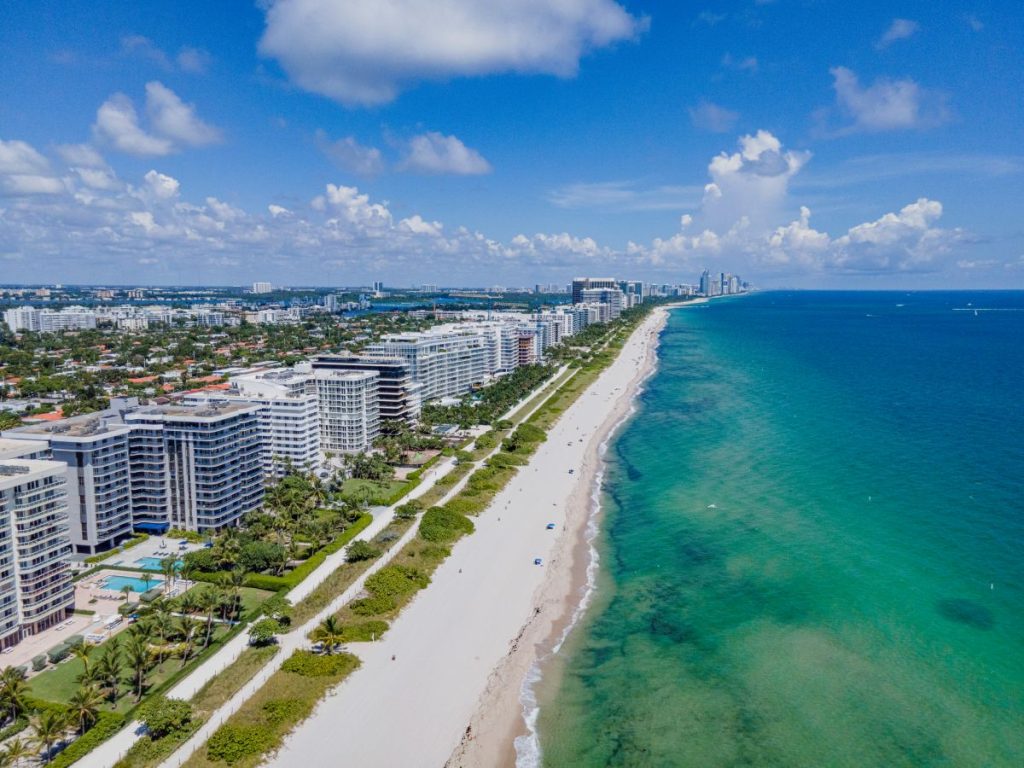
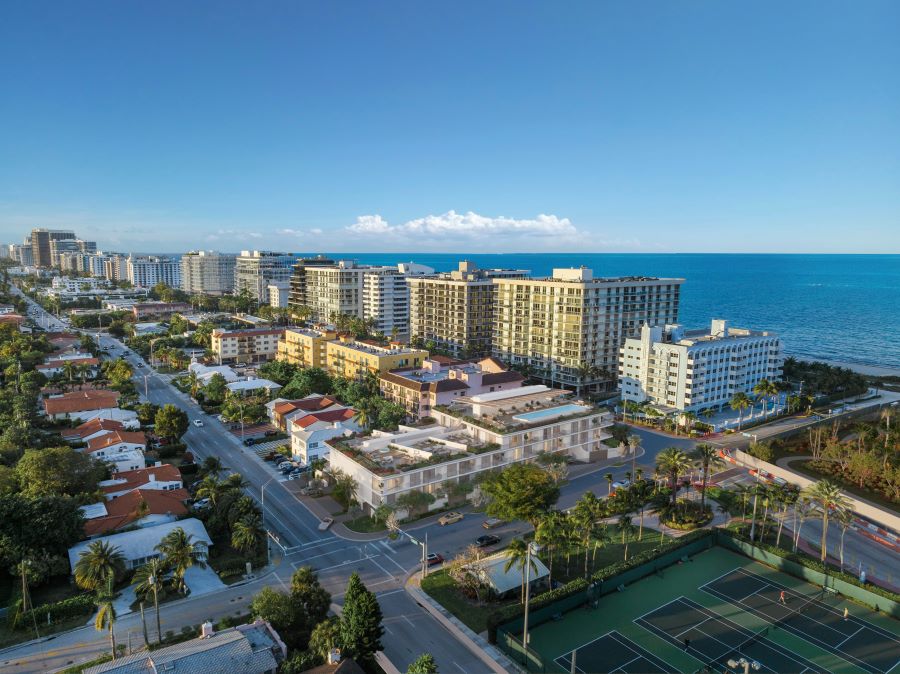
Surfside is a small, incorporated municipality on Collins Avenue between 88th and 96th Streets — bordered by Bal Harbour to the north and Miami Beach to the south, with the Atlantic Ocean to the east and Indian Creek to the west. Incorporated in 1935, it did not see meaningful growth until after World War II, and it has spent most of its history as a quietly residential beach town rather than a headline luxury address.
That quiet character is still the foundation of daily life in Surfside. The town’s Community Center on the ocean at 93rd Street houses the Surf-Bal-Bay Library, a recreation department, and an Olympic-size public swimming pool. Harding Avenue — the town’s low-rise commercial spine, a block back from the beach — is lined with bistros, pizza shops, and the kind of neighborhood-serving retail that Bal Harbour’s high-fashion corridor does not offer. Surfside Beach itself is a full mile of public sand with tennis courts and recreational facilities, distinct from the private beach clubs operated by the town’s hotel-branded towers.
What has changed is not Surfside’s character. It is what is being built within it. A town that spent decades as a modest, walkable beach community immediately south of Bal Harbour Shops is now home to a concentration of nine-figure transactions and Pritzker Prize architecture, all within blocks of the same Harding Avenue pizza shops that have served the town for generations. Not every project in that pipeline is succeeding, and the one that has struggled most is worth understanding clearly — which is the subject of the next section.
The Billionaire’s Triangle: How a Few Blocks Became a Headline
The nickname “Billionaire’s Triangle” has attached itself specifically to the stretch of Collins Avenue around the 9100 and 9300 blocks, where a handful of boutique buildings have produced a concentration of ultra-high transactions disproportionate to the town’s tiny footprint.
In April 2026, a boutique condominium on Collins Avenue with only about ten ultra-luxury residences recorded its first three closings — totaling roughly $121 million combined. In a building that small, three eight-figure deals are enough to instantly reset the comps for everything around it. That activity sits alongside Fort Partners’ Seaway at The Surf Club, which has been recording its own string of multimillion-dollar closings on the same block.
What makes this pattern self-reinforcing is scarcity. Surfside’s land footprint is fixed — there is no meaningful capacity for new oceanfront supply in a town this size. When a handful of boutique towers with ten to forty units each absorb buyers at eight-figure price points, every subsequent listing on that same stretch of Collins Avenue gets priced against those closings, not against the broader county average. That dynamic is the actual mechanism behind the “Billionaire’s Triangle” framing — it is not marketing language, it is a description of how thin-market pricing actually works when transaction volume is this low and individual sale prices are this high.
The Delmore: A Difficult Chapter on Difficult Ground
No discussion of Surfside’s current real estate cycle is honest without addressing The Delmore directly — and addressing it accurately, which means starting with what the site actually is, not what is being built on it.
8777 Collins Avenue is the former site of Champlain Towers South, which collapsed in the early morning hours of June 24, 2021, killing 98 people in the deadliest unintentional building failure in modern American history. A permanent memorial for the victims sits adjacent to the property, and many in the Surfside community — including family members of those who died — have advocated for the entire site to remain a place of remembrance rather than new construction. The courts ultimately ordered the property sold; DAMAC Properties, a Dubai-based developer led by billionaire Hussain Sajwani, was the sole bidder at a 2022 auction, paying $120 million.
DAMAC’s plan for the site, The Delmore, is a 12-story, 37-residence tower designed by Zaha Hadid Architects, with units priced from $15 million and averaging $35 to $40 million, and penthouses potentially exceeding $150 million. Sales launched in January 2025. As of this writing, not a single unit has sold.
The developer has attributed the lack of sales to an early, under-prepared launch — the sales gallery wasn’t completed until several months after marketing began — and to broader softness in the luxury market. Neither explanation holds up well against the surrounding evidence. Surfside condo sales rose 57% in the first quarter of 2026 alone, with average prices up 23% to $6.1 million, and The Surf Club Four Seasons — three blocks away — has continued selling briskly, with a penthouse trading above $6,700 per square foot last summer. The market around The Delmore is not soft. The project itself is the outlier.
The more credible explanation, reported by The Real Deal and echoed by brokers covering the project, is straightforward: buyers do not want to be the first to live where 98 people died. DAMAC’s own development executive has acknowledged as much, noting that prospective buyers consistently cited reluctance to be the first purchaser. A deal for more than $200 million in units came close to closing before DAMAC walked away over concerns about the funding source — the closest the project has come to a sale in eighteen months. DAMAC has confirmed it is in talks to bring in a joint venture partner and is planning a sales relaunch later in 2026, while continuing to work through permitting, insurance, and contractor selection.
For buyers evaluating Surfside’s new development landscape, the honest read is this: The Delmore’s struggles are specific to its site, not to the neighborhood, the architect, or the broader luxury market. The towers actually driving Surfside’s pricing power and absorption in 2026 are The Surf Club Four Seasons, Seaway at The Surf Club, and the FENDI Château Residences — the three buildings that have established Surfside’s real performance track record and that buyers and brokers point to when discussing what is actually working in this market.
The 9100 and 9300 Blocks: What Else Is Rising
Beyond The Delmore and the established Surf Club ecosystem already covered in this guide series, Surfside’s compact development pipeline includes several smaller projects worth knowing by name.
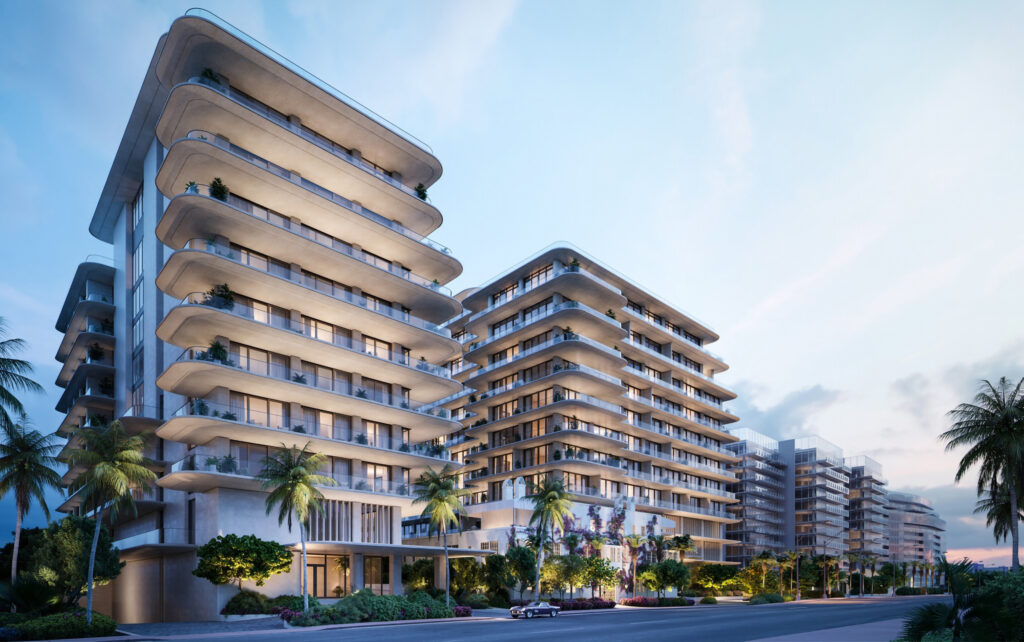
9165 Collins Avenue (“Hillcrest”) — Fort Partners, the same developer behind The Surf Club Four Seasons, secured a $107.6 million construction loan to build a 10-story luxury condominium just north of the Surf Club. Designed by ODP Architecture & Design, the project will house just 14 units ranging from 10,000 to 12,500 square feet — ultra-luxury scale on a 0.54-acre site Fort Partners acquired for $41.5 million in early 2023, after demolishing the prior co-op building. Town of Surfside municipal records confirm the project is under construction.
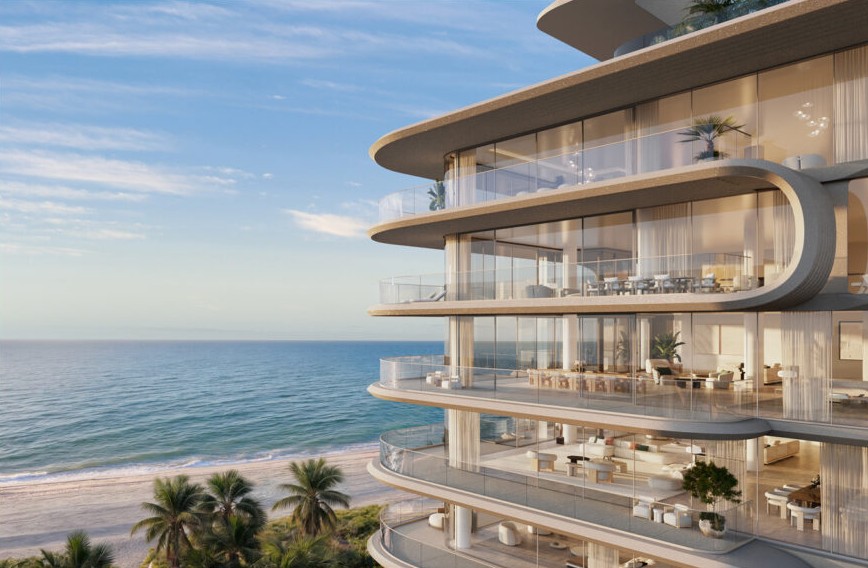
Surf House at 8995 Collins Avenue — designed by Kobi Karp — is an 11-story tower with 19 oversized residences, each with 12-foot-deep terraces, glass railings, and a barefoot path to the beach through landscaped grounds. Completion is expected in 2026.
Surf Row Residences at 8800 Collins Avenue takes a different format entirely: eight single-family beachfront row houses, developed by LD&D in partnership with ONE Capital and IGEQ, designed by Alfonso Jurado Architecture and Boris Pena Architects. For buyers who want Surfside’s oceanfront positioning in a townhouse format rather than a tower residence, Surf Row is the only product of its kind currently active in the town.
9300 Collins Avenue, developed by Kushner, introduces something genuinely different to Surfside’s market: a luxury rental product in a town traditionally dominated entirely by for-sale condominiums. The 68-unit, three-story project broke ground in May 2025 and is targeting late 2026 completion, one block west of the ocean and within walking distance of Bal Harbour Shops.
That rental introduction is worth flagging on its own. Surfside has functioned almost exclusively as an ownership market — the arrival of a purpose-built luxury rental project signals developer confidence that demand in this corridor now extends beyond buyers alone, into a tenant pool willing to pay luxury rental rates for a Surfside address without purchasing.
Pricing: What Surfside Actually Costs Across Its Full Range
Surfside’s pricing data tells a story of genuine range — from accessible inland condos to the eight-figure closings defining the Billionaire’s Triangle.
As of early June 2026, Surfside listing data shows 69 active luxury listings with an average of 157 days on market, an average price per square foot of approximately $2,860, and a median list price of $2.5 million. Broader market data covering the full range of Surfside condo inventory shows 126 active listings spanning from $312,000 to $49,900,000 — an extraordinarily wide range for a single municipality of this size — with a median home price of approximately $1.6 million and an average sale price of roughly $3.46 million, and average days on market around 144.
That dispersion — from a $312,000 entry-level unit to a $49.9 million listing within the same town — is the clearest single illustration of how layered Surfside’s market actually is. A buyer searching “Surfside condos” without local context could land anywhere on that spectrum, and the experience, building quality, and investment thesis at each end are almost entirely unrelated to each other.
At the established-building tier away from the new pre-construction towers, listings like a renovated one-bedroom at The Waverly Surfside or an oceanfront unit at The Carlisle on the Ocean illustrate the town’s more accessible inventory — boutique, often decades-old buildings with direct beach access and proximity to Bal Harbour Shops, priced well below the new-construction and Surf Club tiers.
Surfside vs. Bal Harbour vs. Sunny Isles Beach: The Quick Read
For buyers who have already evaluated Bal Harbour and Sunny Isles Beach elsewhere in this guide series, Surfside’s positioning is best understood as occupying a specific middle ground.
Surfside is smaller and quieter than Sunny Isles Beach, with nothing resembling that corridor’s tower density or its automotive-branded residence portfolio. It is more residential and less retail-driven than Bal Harbour, lacking anything comparable to Bal Harbour Shops within its own borders, but benefiting from being five minutes away from it. What Surfside offers that neither neighbor replicates is the specific combination of a fixed, tiny land footprint with a documented pattern of nine-figure transaction clusters — the Billionaire’s Triangle dynamic is a Surfside-specific phenomenon, not a Bal Harbour or Sunny Isles Beach one.
For buyers who want the Bal Harbour Shops proximity without Bal Harbour’s village-scale formality, or who want oceanfront scarcity without Sunny Isles Beach’s tower density, Surfside is increasingly the answer.
Who Is Buying in Surfside in 2026?
The buyer profile drawn to Surfside’s current cycle splits between two distinct groups, and understanding which one a specific building serves matters more here than in almost any other neighborhood in this guide series.
The first group is the ultra-high-net-worth global buyer specifically targeting the Billionaire’s Triangle’s boutique towers — The Delmore, Seaway, the incoming Hillcrest project — for whom the appeal is precisely the combination of architectural pedigree, extreme scarcity, and a a town small enough that ten to forty fellow owners constitute the entire resident population of an entire building. These buyers are not comparison-shopping against Bal Harbour or Sunny Isles Beach; they have already decided Surfside’s specific scarcity profile is what they want.
The second group is the longer-tenured, more locally-rooted buyer drawn to Surfside’s quieter, more affordable inventory — the Waverly, the Carlisle, the town’s older oceanfront and inland stock — for whom the appeal is walkability to Harding Avenue, proximity to Bal Harbour Shops, and a calmer daily environment than Miami Beach or Sunny Isles Beach offer at a comparable price point.
The arrival of the Kushner rental project introduces a third, smaller cohort: tenants who want a Surfside address without the capital commitment of ownership — a buyer-adjacent group worth watching as a leading indicator of broader demand in the corridor.
Frequently Asked Questions
What is the “Billionaire’s Triangle” in Surfside?
The Billionaire’s Triangle refers to the concentration of ultra-high-value real estate transactions on the 9100 and 9300 blocks of Collins Avenue in Surfside, where boutique towers with as few as ten to forty units have recorded nine-figure transaction totals, creating a self-reinforcing pricing dynamic in a town with essentially no capacity for new oceanfront supply.
What happened to The Delmore in Surfside?
The Delmore has not sold a single unit since sales launched in January 2025. The developer has cited an early, under-prepared launch and broader market softness, but neither explanation holds up against a Surfside market where condo sales rose 57% in Q1 2026 alone. The more credible factor, as reported by The Real Deal, is that the property sits on the former site of Champlain Towers South, where 98 people died in the 2021 collapse — and prospective buyers have consistently cited reluctance to be the first to purchase there. Surf Club, Seaway, and FENDI Château are the buildings actually anchoring Surfside’s market performance in 2026.
Is Surfside expensive?
Surfside’s pricing spans an extremely wide range — from approximately $312,000 for accessible inland or older-building condos to listings above $49 million in its newest ultra-luxury towers. The average price per square foot for active luxury listings is approximately $2,860, with a median list price of around $2.5 million.
How is Surfside different from Bal Harbour?
Surfside is more residential and less retail-driven than Bal Harbour, with no equivalent to Bal Harbour Shops within its own borders, though it sits five minutes away. Surfside’s current cycle is defined by a documented pattern of nine-figure transaction clusters on a small handful of blocks — the Billionaire’s Triangle dynamic — that is specific to Surfside rather than to its neighbors.
What new developments are being built in Surfside right now?
Active projects include The Delmore (DAMAC International, Zaha Hadid Architects, 37 residences), 9165 Collins Avenue (“Hillcrest,” Fort Partners, 14 units), Surf House (Kobi Karp, 19 residences, 2026 completion), Surf Row Residences (eight single-family beachfront row houses), and 9300 Collins Avenue (Kushner, 68-unit luxury rental project, late 2026 completion) — alongside the established Surf Club Four Seasons and Seaway ecosystem covered elsewhere in this guide series.
Is Surfside a good investment in 2026?
Surfside’s fixed, tiny land footprint and documented pattern of nine-figure transactions at buildings like the Surf Club and Seaway point to a strong scarcity-driven thesis at the ultra-luxury tier. At the more accessible tier, the town’s walkability, Bal Harbour Shops proximity, and quieter character than its neighbors continue to support steady demand. The Delmore’s struggles are a useful reminder that scarcity and brand pedigree alone don’t guarantee absorption — site-specific factors matter, and buyers should evaluate each project on its own circumstances rather than assuming every Surfside address performs the same way.
Ready to Explore Surfside?
Surfside is a town that has not changed its character so much as it has been discovered by global capital, which has recognized what its scarcity actually means. A mile of public beach, a handful of pizza shops on Harding Avenue, and — three blocks away — the quiet, ongoing healing of a community still living beside its own tragedy.
I am Ashton Coleman, a luxury real estate specialist with One Sotheby’s International Realty, holding the Certified Luxury Home Marketing Specialist (CLHMS) Million Dollar Guild designation, Certified Negotiation Expert (CNE), Transnational Referral Certification (TRC), and Resort & Second-Home Property Specialist (RSPS) designations. I represent buyers across Surfside’s full range, from its quiet, established inventory to its newest architecturally significant towers.
View current floor plans, pricing, and available luxury condos in Surfside or waterfront homes at MiamiPenthousesandEstates.com, or contact me directly for a personalized comparison between Surfside and Miami’s other ultra-exclusive coastal enclaves.
📞 Call or text: 305.978.7704
📧 Email: AColeman@onesothebysrealty.com
🌐 Search all Surfside luxury condos at MiamiPenthousesandEstates.com
Information provided is for informational purposes only and subject to change without notice. Pricing, availability, and completion dates are based on developer representations and market data current as of Q2 2026. Verify all details directly with the developer or your legal and financial advisors prior to entering any transaction.





