


A $3 million Miami condo does not necessarily have $90,000 of buyer closing costs just because someone told you to “budget 3%.”
That shortcut can be useful for rough planning.
It can also be misleading.
A cash buyer and a financed buyer purchasing the same $3 million Miami Beach condo can receive very different closing statements.
The financed buyer may face mortgage-related documentary stamp tax, Florida intangible tax, lender fees, appraisal charges and other loan expenses that simply don’t exist in the cash transaction.
Meanwhile, property-tax prorations, association charges, prepaid insurance and escrow deposits can move substantial amounts of money across the closing statement without necessarily representing a true transaction “fee.”
So when a buyer asks me:
“How much are closing costs on a Miami condo?”
I first want to know:
Are you paying cash or financing?
Is this resale or new construction?
What does the contract say about title?
What association charges apply?
What exactly are we calling a closing cost?
Those answers matter.
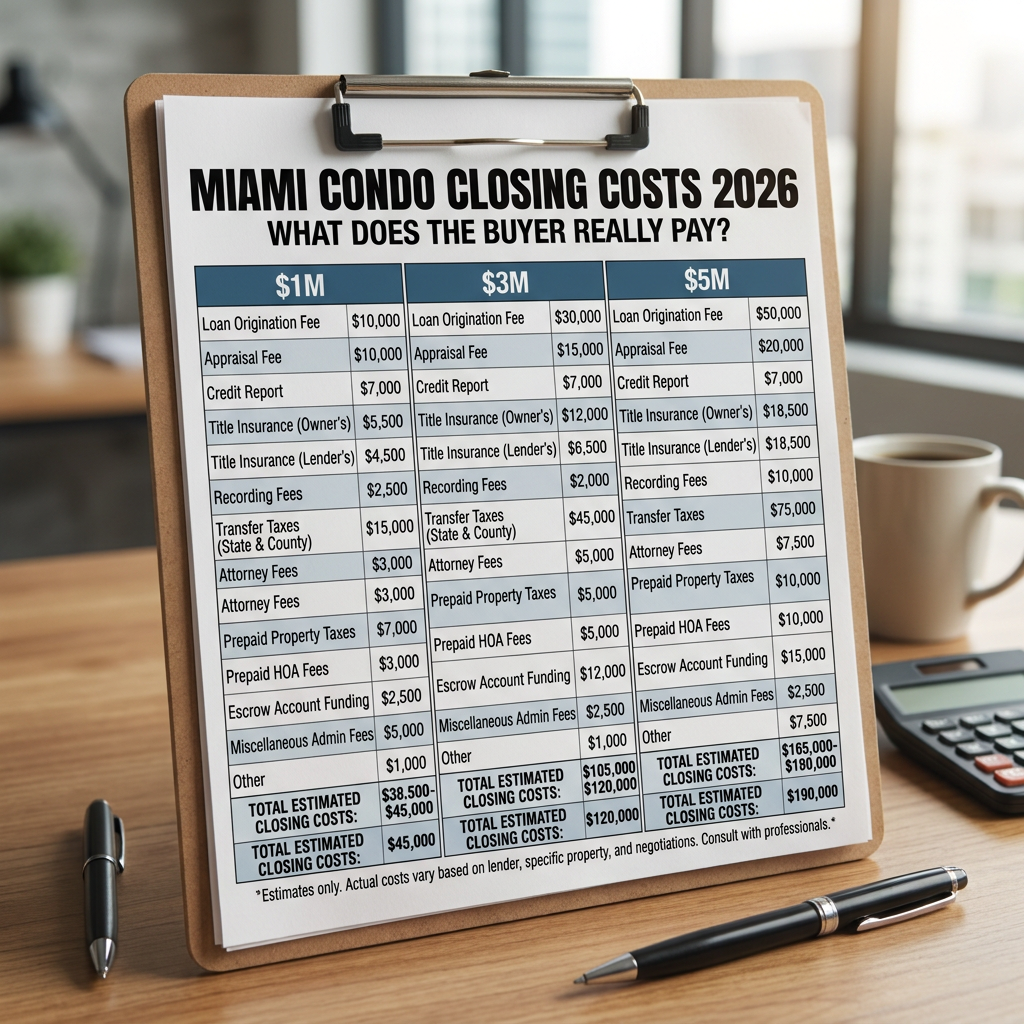
Closing Costs vs. Cash to Close: They Are Not the Same Number
This is the most important distinction in the article.
Closing Costs
These are expenses associated with completing the transaction.
They can include:
- title insurance
- closing/settlement charges
- recording fees
- lender charges
- appraisal
- mortgage taxes
- association-related charges
- inspections
- attorney fees, if applicable
Prepaids and Escrows
These can include money collected in advance for:
- insurance
- property taxes
- prepaid interest
- lender escrow accounts
Cash to Close
This is the larger number.
It can include:
down payment or cash purchase balance
plus:
closing costs
plus or minus:
deposits, credits, prorations, prepaids and other adjustments.
So if a financed buyer wires $1 million at closing, that does not mean the buyer incurred $1 million of closing costs.
Most of that money may simply be equity going into the property.
Who Pays for Title Insurance in Miami-Dade?
Miami-Dade is different from much of Florida.
On a typical Miami-Dade resale transaction, the buyer customarily pays for the owner’s title insurance policy and selects the closing/title agent.
But this is important:
That is custom—not an absolute legal requirement.
The purchase contract controls.
Buyer and seller can negotiate a different arrangement.
Florida regulates title-insurance premium rates, so the base premium itself is not simply whatever a title company decides to charge.
For original owner’s coverage, the Florida rate structure begins at:
$5.75 per $1,000 for the first $100,000
then:
$5.00 per $1,000 from $100,000 through $1 million
then:
$2.50 per $1,000 from $1 million through $5 million.
A prior qualifying owner’s policy can sometimes make reissue rates applicable, so the actual premium should be quoted for the transaction.
What Does Owner’s Title Insurance Cost on a $1M, $3M or $5M Miami Condo?
Using Florida’s original owner’s title-insurance premium schedule before applicable endorsements, credits or reissue treatment:
| Purchase Price | Approx. Original Owner’s Title Premium |
|---|---|
| $1,000,000 | $5,075 |
| $3,000,000 | $10,075 |
| $5,000,000 | $15,075 |
These figures are useful because they illustrate something buyers often misunderstand:
Title insurance does not increase at one flat percentage of the purchase price.
Florida uses a tiered premium structure.
And the title premium is only one component of the closing statement.
Title search, settlement/closing services, endorsements, recording and other charges can be separate.
Cash Buyer: What Costs Should I Expect?
A cash purchase eliminates an entire category of mortgage-related expenses.
A Miami condo cash buyer may still encounter:
Owner’s Title Insurance
Customarily buyer-paid in a Miami-Dade resale transaction, subject to the contract.
Settlement / Closing Charges
These vary by closing agent.
Recording Charges
For documents the buyer is responsible for recording.
Inspection Costs
Potentially including the residence itself and specialized inspections when appropriate.
Condominium Application / Approval Charges
Building-specific and subject to applicable law and condominium documents.
Other Association Charges
Potential transfer, move-in or administrative items need to be verified individually.
Attorney Fees
If the buyer retains separate counsel.
Property-Tax Proration
This can affect the settlement statement substantially but shouldn’t automatically be described as a “fee.”
Insurance
The buyer may pay premiums at or before closing.
What a cash buyer generally avoids are the expenses created specifically by placing a new mortgage on the property.
And those can be meaningful.
Financing Adds Florida Mortgage Taxes
Florida imposes taxes associated with mortgage debt secured by Florida real estate.
Two are particularly important.
Documentary Stamp Tax on the Mortgage / Note
Florida’s documentary stamp tax on mortgages and other taxable obligations is generally:
$0.35 per $100 of indebtedness
or approximately:
0.35% of the loan amount
Florida Nonrecurring Intangible Tax
Florida also imposes a nonrecurring intangible tax on obligations secured by Florida real property.
The rate is:
2 mills — or 0.20%
of the taxable secured obligation.
Combined, those two taxes can equal approximately:
0.55% of the mortgage amount
before lender charges.
That means the amount financed matters—not merely the purchase price.
Example: $1 Million Miami Condo
Let’s compare a cash buyer with a buyer financing 70%, or $700,000.
$1M Cash Purchase
Approximate original owner’s title premium:
$5,075
No new mortgage means:
No new mortgage documentary stamp tax
and:
No new-mortgage nonrecurring intangible tax.
The buyer would still need to account for applicable settlement, recording, inspection, association, insurance and other transaction-specific expenses.
$1M Purchase With $700,000 Mortgage
Owner’s title premium:
~$5,075
Mortgage documentary stamp tax:
$700,000 × 0.35% = ~$2,450
Nonrecurring intangible tax:
$700,000 × 0.20% = ~$1,400
Mortgage taxes alone:
~$3,850
Then add lender-specific expenses such as:
- origination/underwriting charges
- appraisal
- credit-related charges
- lender-required title coverage/endorsements
- prepaid interest
- insurance/escrow requirements where applicable
The financed buyer therefore starts with thousands of dollars in expenses that the cash buyer simply doesn’t have.
Example: $3 Million Miami Condo
Now assume the buyer again finances 70%.
Loan:
Loan amount: $2.1 million
Approximate original owner’s title premium:
Approximate owner’s title premium: $10,075
Mortgage documentary stamp tax:
$2.1M × 0.35% = ~$7,350
Nonrecurring intangible tax:
$2.1M × 0.20% = ~$4,200
Mortgage taxes:
Mortgage taxes: approximately $11,550
Before lender fees.
That’s the key point.
A financed $3 million purchase doesn’t merely have a mortgage payment after closing.
The creation of the mortgage itself can add substantial transaction costs at closing.
Example: $5 Million Miami Condo
At $5 million, assume a 70% loan:
Loan amount: $3.5 million
Approximate original owner’s title premium:
Approximate owner’s title premium: $15,075
Mortgage documentary stamp tax:
$3.5M × 0.35% = ~$12,250
Nonrecurring intangible tax:
$3.5M × 0.20% = ~$7,000
Mortgage taxes alone: approximately $19,250
Again, this is before lender charges, appraisal, applicable title-related loan expenses and prepaids.
This is why a wealthy buyer deciding between cash and financing should evaluate more than the interest rate.
There is also a cost to creating the debt.
Cash vs. Financing: The Core Numbers
Using a 70% mortgage solely as an illustration:
| Purchase Price | Approx. Owner’s Title Premium* | 70% Loan | Mortgage Taxes** |
| $1M | $5,075 | $700K | $3,850 |
| $3M | $10,075 | $2.1M | $11,550 |
| $5M | $15,075 | $3.5M | $19,250 |
*Original owner’s policy rate illustration before potential reissue treatment, endorsements and other title/closing charges.
**Approximately 0.35% documentary stamp tax plus 0.20% nonrecurring intangible tax on the illustrated mortgage amount.
These are not complete closing-cost estimates.
They intentionally isolate several of the more predictable Florida expenses so buyers can understand what changes when financing is introduced.
Why I Don’t Like Saying “Miami Buyer Closing Costs Are 2%–5%”
Because that range hides too much.
Consider a $5 million buyer.
If the buyer pays cash, there is:
no $3.5 million mortgage
and therefore no:
$19,250 of mortgage taxes in our 70%-financing example.
There are also no conventional lender origination or underwriting costs.
Now compare that with another $5 million buyer who finances heavily, pays points to obtain a particular rate, establishes lender-required escrows and incurs substantial loan expenses.
Same condo price.
Completely different closing economics.
A percentage can be useful for setting aside cash.
It is not a substitute for a closing-cost worksheet.
Why a $5 Million Cash Purchase Can Have Surprisingly Efficient Closing Costs
Higher purchase price doesn’t necessarily mean proportionally higher transaction costs.
Some expenses scale with value.
Others don’t.
Title insurance uses a declining tier structure.
A $5 million cash buyer does not pay mortgage taxes simply because the residence is expensive.
Meanwhile, a lower-priced but highly leveraged purchase can generate substantial financing-related expenses.
So I prefer to calculate closing costs line by line.
What About Documentary Stamp Tax on the Deed?
This is where buyers can easily confuse two completely different taxes.
Florida imposes documentary stamp tax on the deed transferring real estate.
Miami-Dade has its own rate structure.
But in a typical Miami-Dade resale transaction, the seller customarily pays the deed documentary stamp taxes under the usual contract allocation.
Again:
The contract controls the transaction.
The buyer should not simply assume every tax associated with the closing belongs on the buyer’s side.
And the deed tax should not be confused with documentary stamp tax imposed on the buyer’s new mortgage debt.
Those are separate taxes.
Miami-Dade’s Deed Surtax Deserves Special Attention
Miami-Dade differs from the rest of Florida.
The Florida Department of Revenue states that Miami-Dade’s deed documentary stamp tax is generally $0.60 per $100 of consideration, plus a $0.45-per-$100 discretionary surtax.
The discretionary surtax has an exemption for transfers of a single-family dwelling. Condominium transfers generally need to be analyzed separately rather than assuming that exemption applies.
However, in an ordinary Miami-Dade resale transaction where the contract allocates deed documentary stamps to the seller, this is generally a seller-side issue rather than a buyer closing-cost line.
New-development contracts can allocate costs differently.
Read the contract.
What About Property Taxes at Closing?
Property taxes create another source of confusion.
Florida property taxes are generally paid in arrears.
At closing, taxes are commonly prorated between buyer and seller based on the applicable contractual and closing calculations.
That adjustment can appear on the settlement statement.
But a tax proration is not the same thing as paying a title-company fee.
And the seller’s historical property-tax bill should not be used blindly to predict the buyer’s future annual tax liability.
For the ownership side of that issue, see:
Miami Condo Carrying Costs 2026: What Does a $1M, $2M, $5M or $10M Condo Really Cost to Own?
What Condo Association Fees Can Appear Around Closing?
Condo transactions introduce another layer.
Depending on the building and transaction, buyers may encounter items related to:
- application
- transfer approval
- screening
- move-in procedures
- deposits
- association documentation
- other building-specific requirements
But buyers should not assume an association can simply invent unlimited transfer fees.
Florida condominium law restricts certain transfer-approval charges and ties them to whether association approval is required and authorized by the condominium documents.
The association’s specific governing documents and current fee schedule should therefore be reviewed.
What Is an Estoppel Certificate?
An estoppel certificate is an association document used to establish amounts and obligations associated with the unit.
It can address items such as:
- regular assessments
- outstanding balances
- special assessments
- other amounts owed to the association
Florida law regulates the preparation and delivery of condominium estoppel certificates and limits applicable charges.
But the existence of an estoppel charge does not automatically mean it belongs economically to the buyer.
Who ultimately bears a particular closing expense can depend on the contract and transaction.
The more important buyer issue is making sure the association’s financial obligations affecting the unit are accurately identified before closing.
Lender Fees Can Vary Dramatically
Unlike Florida’s regulated base title-insurance premium, lender pricing is not one universal number.
Depending on the loan, buyers can encounter:
Origination Charges
Underwriting / Processing Charges
Appraisal
Luxury and jumbo properties can require more complex valuations.
Discount Points
A buyer may voluntarily pay additional money at closing to obtain a different interest rate.
Credit and Verification Charges
Lender’s Title Coverage and Endorsements
Prepaid Interest
Insurance Requirements
Escrow Deposits
Not all of these should be treated identically.
For example:
a discount point is a financing cost
while:
an escrow deposit remains the buyer’s money earmarked for future expenses.
That’s why I separate fees from prepaids.
Closing Costs vs. Prepaids
Suppose the closing statement requires:
$15,000 of property-tax escrow
and:
$8,000 of insurance-related funding.
A buyer might say:
“That’s another $23,000 of closing costs.”
Maybe not.
Some of that money may simply be funding future obligations in advance.
It still affects:
cash required to close
but it shouldn’t necessarily be compared directly with:
title premium
mortgage tax
or:
lender origination fee.
Different economic purpose.
Does a Cash Buyer Need Title Insurance?
A cash buyer does not have a mortgage lender requiring a lender’s title policy.
But that doesn’t make ownership risk disappear.
An owner’s title policy protects the owner’s interest against covered title defects and claims subject to the terms, exclusions and exceptions of the policy.
For a multimillion-dollar purchase, declining title protection simply because the buyer has enough cash to close deserves careful consideration with the buyer’s attorney or title professional.
Cash removes the lender.
It does not remove title risk.
New Construction Can Be Completely Different
Do not assume this resale closing-cost framework applies unchanged to a developer contract.
A new-development purchase can involve:
- developer-specific contract terms
- substantial staged deposits
- different allocations of documentary stamp taxes
- developer closing charges
- association contributions
- working-capital contributions
- title-related provisions
- transfer or administrative charges
- other project-specific costs
The developer’s contract controls many of these obligations.
This is one reason I recommend reviewing the entire closing-cost section of a new-development contract, not merely asking:
“What percentage should I budget?”
For the broader new-development market, see:
Miami Luxury Pre-Construction Condo Market Report 2026
Foreign Buyers: Are Closing Costs Different?
The core purchase expenses don’t suddenly become a different system because the buyer lives outside the United States.
But foreign buyers can encounter additional considerations involving:
- financing availability
- entity ownership
- international wire procedures
- tax planning
- estate planning
- banking compliance
- legal advice
FIRPTA, importantly, is generally a seller-side withholding regime involving a foreign seller, not a generic tax imposed merely because the purchaser is foreign.
International buyers should obtain appropriate U.S. legal and tax advice before structuring ownership.
Does Financing a Condo Affect More Than Closing Costs?
Absolutely.
Before worrying about mortgage taxes and lender fees, the buyer needs to know whether the condominium project itself works for the intended loan program.
A financially qualified borrower can still encounter financing problems because of the building.
I cover that separately in:
Miami Condo Financing 2026: Why the Buyer Can Qualify but the Building Can Still Fail
What I Would Request Before Closing
For a Cash Buyer
I want a preliminary settlement statement showing:
- Purchase price
- Deposits already paid
- Owner’s title premium
- Settlement/title charges
- Recording charges
- Association-related charges
- Tax prorations
- Credits
- Other contractual adjustments
- Final cash required to close
For a Financed Buyer
I want those same items plus:
- Loan amount
- Mortgage documentary stamp tax
- Nonrecurring intangible tax
- Lender charges
- Appraisal
- Points, if any
- Prepaid interest
- Insurance requirements
- Escrow funding
- Lender/title-related charges
Then I separate true transaction costs from prepaids and from equity/down payment.
That gives the buyer a much more useful picture.

Frequently Asked Questions About Miami Condo Closing Costs
How much are closing costs on a Miami condo?
There is no single reliable percentage. Cash and financed purchases can have materially different costs, and title allocation, loan size, association charges, contract terms and prepaids all affect the final number.
Who pays for title insurance in Miami-Dade?
In a typical Miami-Dade resale transaction, the buyer customarily pays for the owner’s title policy and commonly selects the closing/title agent. This is local custom rather than an absolute statutory requirement, and the purchase contract controls.
How much is title insurance on a $1 million Florida condo?
Using Florida’s original owner’s title-insurance premium schedule, approximately $5,075 before possible reissue treatment, endorsements and other title/closing charges.
How much is title insurance on a $3 million condo?
Approximately $10,075 under the original owner’s premium schedule before applicable adjustments.
How much is title insurance on a $5 million condo?
Approximately $15,075 under the original owner’s premium schedule before applicable adjustments.
What Florida taxes does a financed buyer pay on the mortgage?
Florida documentary stamp tax on taxable mortgage indebtedness is generally 0.35%, while the nonrecurring intangible tax is generally 0.20%, producing a combined planning figure of approximately 0.55% of the taxable mortgage amount.
Does a cash buyer pay those mortgage taxes?
There is no new mortgage indebtedness in an all-cash acquisition, so those new-mortgage taxes generally do not arise.
Does the Miami condo buyer pay documentary stamps on the deed?
In a typical Miami-Dade resale transaction, deed documentary stamps are customarily allocated to the seller, subject to the purchase contract. Do not confuse deed documentary stamps with documentary stamp tax on a buyer’s new mortgage.
Are property-tax prorations closing costs?
They affect the settlement statement and cash to close but are better understood as transaction adjustments rather than title or lender fees.
Are prepaid taxes and insurance closing costs?
They affect cash required at closing but economically differ from transaction fees because they generally fund future obligations.
Does a financed purchase cost more to close than a cash purchase?
Usually, all else equal, because financing introduces mortgage taxes and lender-related expenses that don’t exist in an all-cash transaction.
Are new-construction closing costs the same as resale?
Not necessarily. Developer contracts can allocate expenses very differently and may include project-specific charges and contributions.
So What Should a Miami Condo Buyer Budget?
I wouldn’t start with:
“3%.”
I’d start with the actual transaction.
For a cash buyer:
**Purchase price
- title/closing expenses
- association expenses
- inspections
- prorations/prepaids
− deposits and credits**
For a financed buyer:
**all of the above
- mortgage taxes
- lender expenses
- financing prepaids/escrows
− loan proceeds**
That produces the number that actually matters:
Cash Required to Close
And then I would calculate something different:
Actual Cost of the Transaction
Those two numbers are not interchangeable.
A buyer purchasing a $5 million Miami Beach condo should understand both.
For a private comparison of Miami and Miami Beach condominiums—including acquisition price, buyer closing costs, carrying costs, building finances and financing considerations—contact me directly.
📞 Call or text: 305.978.7704
📧 Email: AColeman@OneSothebysRealty.com
Explore Miami Condo Buyer Resources
Miami Condo Carrying Costs 2026 →
Older Miami Beach Condos on Collins Avenue: Bargain or Risk? →
Explore Miami Beach Luxury Condos →
About the Closing-Cost Calculations
This article reflects Florida and Miami-Dade closing-cost rules and practices reviewed in August 2026.
Florida’s original owner’s title-insurance premium rates are established under Florida’s title-insurance rules. The illustrations in this article use the applicable original premium tiers through $5 million and do not assume eligibility for reissue rates or other discounts.
Mortgage documentary stamp tax illustrations use $0.35 per $100 of taxable indebtedness, and nonrecurring intangible tax illustrations use 2 mills, or 0.20%, of the taxable obligation secured by Florida real property.
The financed examples assume 70% loan-to-value solely for illustration. Actual loan amounts, lender charges, title charges, association expenses, escrows and prepaids will vary.
Miami-Dade title-payment practices and other customary expense allocations are not substitutes for the purchase contract. Buyer and seller obligations should be determined from the executed agreement and the specific transaction.
New-development contracts may allocate closing expenses differently from resale contracts.

Information is provided for general real-estate education only and is subject to change. Closing costs, title premiums, taxes, recording charges, lender fees, association charges, contract allocations and other expenses should be independently verified with the appropriate title company, closing attorney, lender, condominium association and professional advisors. Nothing herein constitutes legal, tax, accounting, mortgage or financial advice.





