


Miami condo buyers in 2026 face an increasingly expensive question:
Is a new condominium actually worth the premium over resale?
The answer isn’t automatically yes or no. But Downtown Miami and Brickell closed-sale data gives us something better than opinion.
A review of 266 closed $1 million-plus condominium sales and 602 active listings across Downtown Miami and Brickell shows something most marketing material will not tell you.
New construction commands a substantial premium on the way in. It also carries the market’s widest gap between asking price and closing price, the longest marketing times, and the deepest pool of competing inventory.
Both things are true at once. Understanding why is the difference between paying a premium and overpaying for one.
The Short Answer
Within this Downtown and Brickell dataset:
- Newly delivered buildings (2024 to 2026) closed at a median of $1,262 per square foot
- Pre-2008 buildings closed at a median of $829 per square foot
- That is a 52% newness premium
But:
- Newly delivered buildings required a median of 230 days on market, versus 135 to 147 days for older buildings
- They closed at a median of 90% of list price, versus 93% to 94% for established buildings
- Their asking prices sit 25% above their actual closing prices, the widest gap of any vintage
- They represent 32% of active inventory but only 12% of closed sales
The premium is genuine. The liquidity behind it is thinner than the pricing implies.
Downtown and Brickell Is a Buyer’s Market by Every Standard Measure
Before analyzing vintage, the broader context matters.
TrendGraphix data for August 2026 covering $1 million-plus condominiums in ZIP codes 33128, 33129, 33130, 33131 and 33132 shows:
| Metric | August 2026 |
|---|---|
| Active listings | 639 |
| Closed sales | 21 |
| Months of inventory | 30.4 |
| Average days on market | 125 |
| Average sold price per square foot | $1,073 |
| Sold to original list price | 92% |
A market is generally considered a buyer’s market above six months of inventory.
Downtown and Brickell is at 30.4 months.
Active inventory is up 55.1% compared with August 2023. Closed sales in August 2026 were down 40% against the same month three years earlier.
That is the environment in which the new-construction premium has to be justified.
The Vintage Table: What Actually Closed
This is the core of the analysis. Every row represents closed MLS transactions, not asking prices.
| Building vintage | Closed sales | Median sold price | Median sold $/SF | Median CDOM | Sold/List |
|---|---|---|---|---|---|
| Pre-2008 | 100 | $1,500,000 | $829 | 147 | 94% |
| Boom-era 2008-2018 | 102 | $1,263,250 | $830 | 135 | 93% |
| Recent 2019-2023 | 32 | $1,576,750 | $1,005 | 184 | 94% |
| Newly delivered 2024-2026 | 32 | $2,475,000 | $1,262 | 230 | 90% |
Two observations deserve attention.
First, the premium is not incremental. It is a step function. Pre-2008 and boom-era buildings close at nearly identical figures, $829 and $830 per square foot. The market is not paying meaningfully more for a 2015 building than a 2005 building. The premium arrives only with genuinely current product.
Second, every liquidity measure moves the wrong direction as vintage gets newer. Marketing time lengthens. The discount off list price widens. That is the opposite of what a scarcity premium should look like.
The Delivery Gap
Here is the measurement I find most useful, and it is one buyers rarely see.
Compare what each vintage cohort is asking against what that same cohort is actually closing at.
| Building vintage | Median asking $/SF | Median closing $/SF | Delivery Gap |
|---|---|---|---|
| Pre-2008 | $1,002 | $829 | 17% |
| Boom-era 2008-2018 | $919 | $830 | 10% |
| Recent 2019-2023 | $1,200 | $1,005 | 16% |
| Newly delivered 2024-2026 | $1,686 | $1,262 | 25% |
| Pre-construction 2027+ | $1,974 | No closed sales | Unmeasured |
I call this the Delivery Gap: the spread between what a vintage cohort asks and what it demonstrably gets.
Boom-era buildings show a 10% gap. Sellers in those buildings are pricing close to where the market transacts.
Newly delivered buildings show a 25% gap. Asking prices in 2024-to-2026 towers sit a quarter above the evidence.
This does not mean every new-construction listing is overpriced. Product mix matters enormously, and the active pool in new buildings skews toward larger residences and penthouses that have not yet traded.
But it does mean something practical: in newly delivered Downtown and Brickell buildings, the asking prices are not the comparable sales. A buyer who anchors to list prices in a new tower is anchoring to a number the market has not yet validated.
The Newness Imbalance: 32% of the Inventory, 12% of the Sales
This is the single statistic I would put in front of any buyer considering a premium for new construction in this submarket.
| Building vintage | Active listings | Closed sales | Active per closed sale |
|---|---|---|---|
| Pre-2008 | 106 | 100 | 1.1 |
| Boom-era 2008-2018 | 217 | 102 | 2.1 |
| Recent 2019-2023 | 86 | 32 | 2.7 |
| Newly delivered 2024-2026 | 151 | 32 | 4.7 |
| Pre-construction 2027+ | 42 | 0 | No closed evidence |
Buildings delivered in 2024 or later account for 32% of active $1 million-plus inventory in Downtown and Brickell.
They account for 12% of closed sales.
Pre-2008 buildings show roughly one active listing for every closed sale. Newly delivered buildings show nearly five.
A future seller in a pre-2008 building is competing with approximately one comparable alternative. A future seller in a 2024 tower is competing with nearly five.
That is the exit math that a newness premium has to survive.
Case Study: Aston Martin Residences
Aston Martin Residences at 300 Biscayne Boulevard Way delivered in 2024. It is the most transacted newly delivered building in this dataset, which makes it the most useful test case.
| Aston Martin Residences | Figure |
|---|---|
| Active listings | 43 |
| Median asking price | $2,980,000 |
| Median asking $/SF | $1,674 |
| Median active CDOM | 265 days |
| Closed sales | 25 |
| Median sold price | $2,500,000 |
| Median sold $/SF | $1,229 |
| Median closed CDOM | 254 days |
| Median sold to list | 90% |
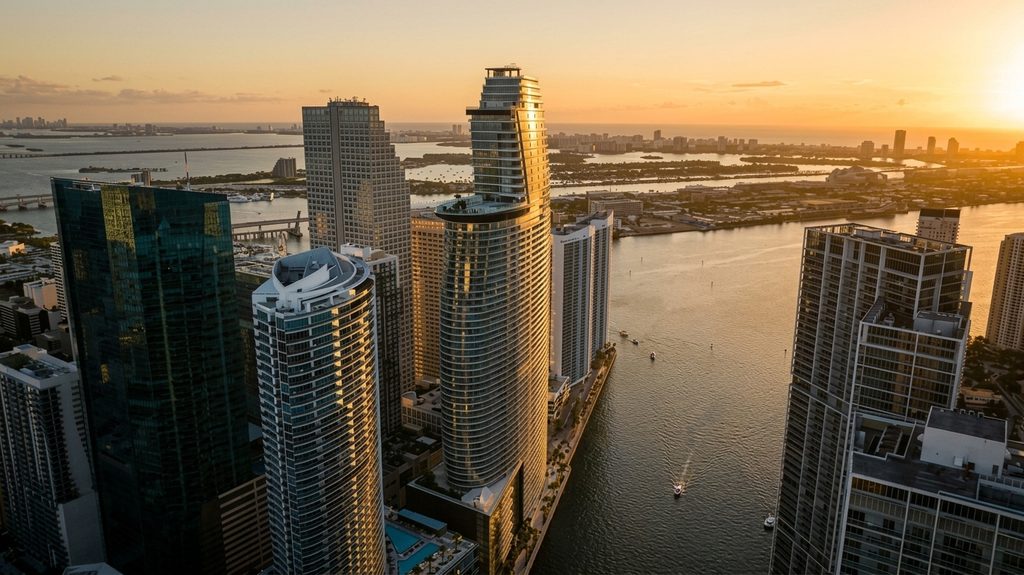
The building is producing real transaction volume. Twenty-five closed sales is meaningful depth for a building barely two years past delivery, and it is considerably more evidence than most new towers can show.
But the individual transactions tell the fuller story.
| Residence | List price | Sold price | Sold $/SF | CDOM |
|---|---|---|---|---|
| #1101 | $5,750,000 | $4,650,000 | $1,276 | 152 |
| #4401 | $5,500,000 | $5,100,000 | $1,323 | 440 |
| #3307 | $3,250,000 | $2,650,000 | $1,130 | 443 |
| #1607 | $2,050,000 | $1,950,000 | $950 | 599 |
| #3605W | $2,550,000 | $2,100,000 | $1,353 | 60 |
| #3305W | $2,790,000 | $2,500,000 | $1,611 | 31 |
Some residences transacted quickly and strongly. #3305W closed in 31 days at $1,611 per square foot. #3605W closed in 60 days.
Others required extraordinary patience. #1607 closed after 599 cumulative days. #3307 closed after 443 days at $600,000 below list.
The median sold price of $2,500,000 against a median asking price of $2,980,000 across 43 active listings tells a seller exactly what they need to know: the building trades, but it trades below where it lists, and it takes roughly eight months to do it.
This is not a criticism of the building. Aston Martin Residences is an architecturally significant tower with genuine brand distinction and waterfront positioning. The point is narrower and more useful: a premium paid at purchase must be recovered in a building where 43 residences currently compete for the next buyer.
The Pre-Construction Tier Has No Closed Evidence At All
The 2027-and-later cohort deserves separate treatment because it cannot be evaluated the same way.
Forty-two active listings in this dataset are in buildings with expected delivery in 2027 or 2028. Median asking price is $4,538,450. Median asking price per square foot is $1,974.
Closed sales in this cohort: zero.
Waldorf Astoria Residences Miami illustrates the point clearly. The dataset contains 20 active Waldorf listings, with a median ask of $8,981,668 and a median asking price of approximately $2,790 per square foot. There are no closed MLS resales to compare them against, because the building has not delivered.
This is not a flaw in the building. It is a structural feature of pre-construction.
But it does mean a buyer at $2,790 per square foot in a 2028 delivery is paying roughly three times the $829 per square foot that pre-2008 Downtown and Brickell buildings are currently closing at, and doing so without a single resale transaction to reference.
That may prove to be an excellent decision. Baccarat, Waldorf Astoria, St. Regis Residences Brickell and other branded projects may establish price levels the existing market has never seen.
It simply cannot be verified from closed data today. Buyers should know which of those two things they are relying on.
Is the Newness Premium Justified?
Sometimes yes. There are real, substantive reasons buyers pay more for current product.
Building systems and reserves. Post-Surfside structural reserve requirements have materially raised carrying costs in older Florida condominiums. A 2024 building with new systems and no deferred maintenance carries a genuinely different assessment risk profile than a 1997 building facing a milestone inspection. That difference has economic value and is arguably the strongest argument for the premium.
Ceiling heights, floor plans and finish levels. Contemporary luxury towers are built to specifications older buildings cannot retrofit. Ceiling height in particular cannot be renovated.
Amenity programming. Current-generation amenity decks, wellness floors and service models are difficult to replicate in an existing structure.
Brand and design authority. A Zaha Hadid or Aston Martin or Waldorf Astoria association is not available at any price in a conventional building.
Those are real. What the data cautions against is different.
It cautions against assuming the premium is automatically recoverable. The 25% Delivery Gap and the 4.7-to-1 active-per-sale ratio suggest that in this particular submarket, at this particular moment, newness is being priced as though it is scarce while the inventory data shows it is the most abundant category in the market. The underlying reason is that newness is not an irreplaceable attribute. Every building is new exactly once, and the premium expires on a schedule that land, frontage, exposure and view permanence do not follow. The irreplaceability premium framework sets out which attributes hold value and which get outbuilt.
What This Means for Buyers
If you are considering a premium for new construction in Downtown Miami or Brickell, I would work through five questions.
1. What has this specific building actually closed at?
Not the neighborhood. Not the asking prices down the hall. The closed sales in this building, in comparable lines.
2. How many residences currently compete with the one you want?
Aston Martin has 43 active listings. A pre-2008 building may have three. Those are different ownership propositions even at the same price per square foot.
3. What is the Delivery Gap in this building?
If listings ask $1,700 per square foot and closings land at $1,250, you now know where the negotiation actually starts.
4. What portion of the premium is buying structural certainty rather than newness?
Reserve funding, milestone inspection status, and assessment history in the older alternative should be priced explicitly. If the older building has a funded reserve and a completed inspection, a meaningful part of the new-construction argument weakens. 4. What portion of the premium is buying structural certainty rather than newness?
Reserve funding, milestone inspection status, and assessment history in the older alternative should be priced explicitly. If the older building has a funded reserve and a completed inspection, a meaningful part of the new-construction argument weakens. My Miami condo due diligence checklist covers what to request and when.
5. If you needed to sell in three years, who is the next buyer, and what else will they be able to buy in your building?
In a building with 4.7 active listings per sale, the answer requires more thought than in one with 1.1.
What This Means for Sellers
If you own in a newly delivered Downtown or Brickell tower, the data is direct.
Your competition is inside your own building. With 151 active listings in 2024-to-2026 buildings against 32 closed sales, the binding constraint is not whether a buyer wants new construction. It is whether they want yours over four alternatives.
The median closed sale in your cohort landed at 90% of list. Pricing at the building’s highest ask because your residence is superior does not create leverage if the evidence does not support it. It usually creates another long-standing listing.
Budget 230 days. That is the median for your cohort, not the worst case.
If you own in an established building, the position is different and often better than owners assume. Pre-2008 buildings closed at 94% of list in 147 days with roughly one competing listing per sale. That is a tighter, more efficient market than the premium tier above it. The pricing is lower per square foot. The path to a transaction is shorter.
Frequently Asked Questions
Is new construction worth the premium in Miami?
It depends on what the premium is buying. In Downtown Miami and Brickell, newly delivered buildings close at a median of $1,262 per square foot against $829 for pre-2008 buildings, a 52% premium. Structural reserves, building systems, ceiling heights and amenity programming are genuine justifications. However, new construction also shows the longest marketing times and the widest gap between asking and closing prices in the market, so the premium should be evaluated against the specific building’s closed sales rather than assumed.
How much more does new construction cost per square foot in Brickell and Downtown Miami?
In this dataset of 266 closed $1 million-plus sales, buildings delivered 2024 or later closed at a median of $1,262 per square foot. Buildings from 2019 to 2023 closed at $1,005. Buildings from 2008 to 2018 closed at $830, and pre-2008 buildings closed at $829.
Do new Miami condos sell faster than resale condos?
No. In this dataset, newly delivered buildings required a median of 230 cumulative days on market, compared with 147 days for pre-2008 buildings and 135 days for 2008-to-2018 buildings.
Do new construction sellers get closer to asking price?
No. Newly delivered buildings closed at a median of 90% of list price, the lowest of any vintage cohort. Pre-2008 buildings closed at 94% and boom-era buildings at 93%.
Is Downtown Miami or Brickell a buyer’s market in 2026?
Yes, by the standard measure. August 2026 showed 30.4 months of inventory based on closed sales for $1 million-plus condominiums, well above the six-month threshold that defines a buyer’s market. Active inventory stood at 639 units against 21 closed sales that month.
Should I buy pre-construction in Brickell?
Pre-construction can be an excellent decision, but it cannot be validated with closed-sale evidence. In this dataset, 42 active listings in buildings delivering 2027 or later carried a median asking price of $1,974 per square foot, with zero closed resale transactions available for comparison. A buyer is underwriting a price level that the existing market has not yet demonstrated.
Does a long days-on-market figure mean a building is undesirable?
Not necessarily. Cumulative days on market can reflect ambitious initial pricing, relisting history, unusual residences, seller motivation or a small buyer pool. It is most useful alongside closed transaction count and current competing inventory, which is why this analysis reports all three together.
Methodology and Data Disclosure
This analysis uses supplied SEFMLS condominium records for Downtown Miami and Brickell covering $1 million-plus properties, comprising 602 active listings and 266 closed sales with reported sale prices and build years. Market context figures come from TrendGraphix Facts and Trends reports published September 2026, reflecting data through the end of August 2026, for condominiums priced $1,000,000 and above in ZIP codes 33128, 33129, 33130, 33131 and 33132.
Vintage cohorts use the MLS year-built field. For projects not yet delivered, that field reflects expected delivery, which is why the 2027-and-later cohort contains active listings only.
Several caveats matter. Closed sales in recently delivered buildings may include early resales by original purchasers rather than a mature secondary market, and those transactions can behave differently from long-term owner-to-owner resales. Product mix varies substantially between cohorts, with newer buildings skewing toward larger residences and penthouses. Cumulative days on market can be affected by relisting history. Median figures are used throughout rather than averages, specifically to limit distortion from outlier transactions, but medians in cohorts with 32 closed sales carry more uncertainty than those with 100.
This analysis does not rank buildings and should not be read as one. MLS information is believed accurate but is not guaranteed.
Disclaimer
This article is provided for general real estate information and marketing purposes and is not an appraisal or financial, tax, legal, or investment advice. Individual residences, buildings, marketability and resale outcomes vary substantially. Buyers and sellers should evaluate property-specific information and current market conditions before making a real estate decision.
Considering a Downtown Miami or Brickell Condominium?
The question is rarely whether new construction is better than resale.
It is whether the specific premium on the specific residence you are considering is supported by what that building has actually closed at, and whether the exit will be crowded when you eventually want to sell.
Before buying or selling at Aston Martin Residences, Waldorf Astoria Residences Miami, UNA Residences, One Thousand Museum, Baccarat Residences, St. Regis Residences Brickell, Echo Brickell, Brickell Flatiron, Millennium Tower, Santa Maria, or another Downtown or Brickell condominium, the residence should be measured against the right closed transactions rather than the asking prices surrounding it.
Contact Ashton Coleman for a private Downtown Miami or Brickell condominium valuation, buyer analysis, or a building-specific closed-sale and resale positioning review.
📞 305.978.7704
📧 AColeman@onesothebysrealty.com





