


The marble floors are beautiful. The ocean view is ridiculous. The kitchen looks untouched.
None of that tells you whether you’re buying into a financially healthy condominium.
In Miami, you’re not simply buying a residence. You’re also buying into a building, an association, a budget, a maintenance history and a collection of future financial obligations you don’t control by yourself.
That makes condominium due diligence different from evaluating a single-family home.
The residence is what you see. The building is where some of the biggest surprises can hide.
For Miami condo buyers in 2026, understanding both matters.
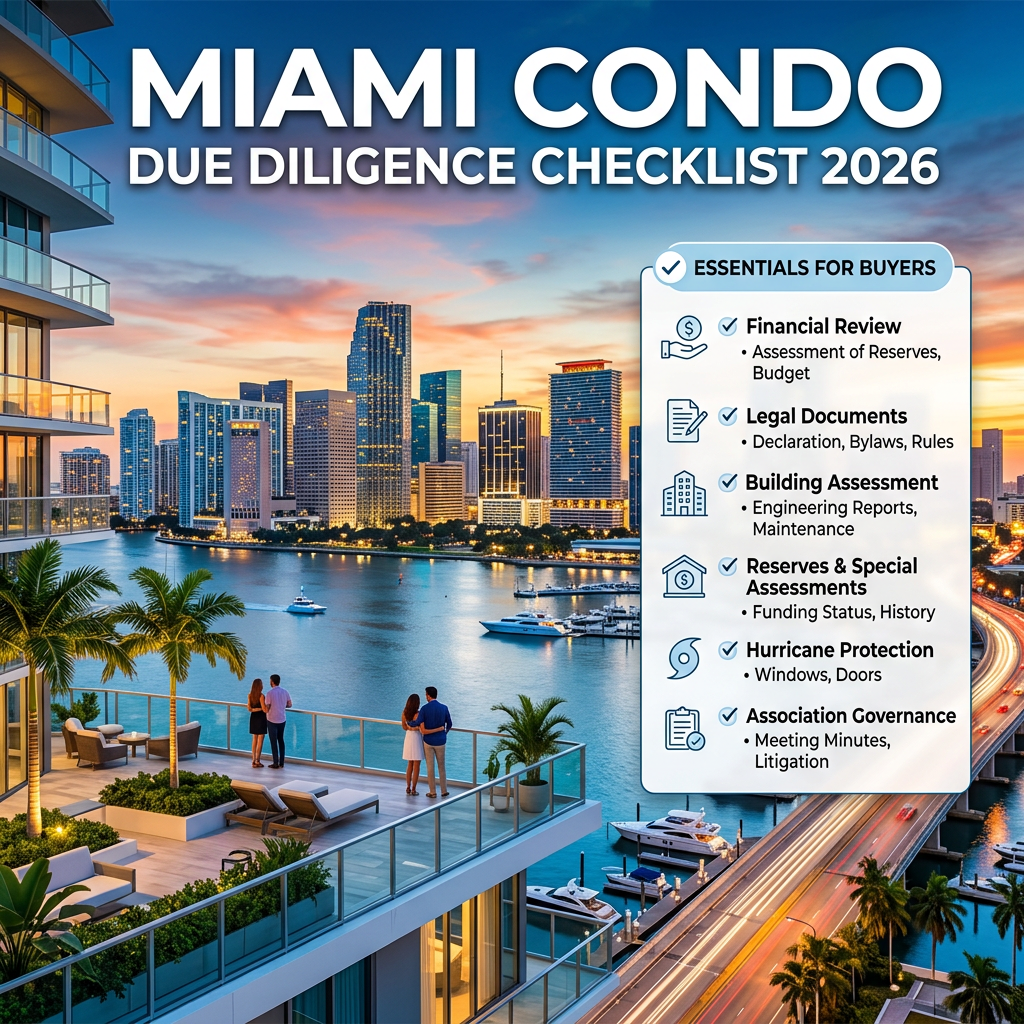
Start With the Building, Not Just the Unit
Buyers naturally focus on the residence.
Is the view good?
Is the floor plan functional?
Does it need renovation?
Is the asking price reasonable?
Those questions matter, but a spectacular residence cannot completely insulate an owner from problems elsewhere in the condominium.
Before buying, I want to understand three things:
What condition is the residence in?
What condition is the building in?
What condition are the association’s finances in?
Those are separate questions.
A beautifully renovated condo can exist inside a building facing expensive capital work.
Likewise, an older residence requiring renovation can exist inside a financially strong, well-maintained condominium.
Don’t confuse the condition of the unit with the condition of the building.
1. Review the Condominium Association’s Financials
One of the first things I want to understand is how the association handles money.
That includes reviewing available financial statements, budgets and reserve information.
You’re looking beyond the current monthly condominium fee.
Questions worth asking include:
- What does the association collect annually?
- What are its major expenses?
- What reserves exist?
- What major projects are anticipated?
- Are there substantial receivables or delinquencies?
- Have operating expenses increased significantly?
- Are owners currently paying assessments?
- Are additional assessments being discussed?
A low condominium fee can look attractive.
But low fees aren’t automatically evidence of an inexpensive building.
If contributions have historically been insufficient to address major future work, today’s savings can become tomorrow’s assessment.
2. Understand Reserves
Reserves are money accumulated for major building components and future capital expenses.
For buyers, the important question isn’t simply:
“Does the building have reserves?”
It’s:
“Are the building’s reserves appropriate for the work it expects to face?”
A large reserve balance may sound impressive until you compare it with the cost of major concrete work, roofing, elevators, mechanical systems, waterproofing or other capital projects.
Conversely, a building that recently completed substantial work may present a very different financial picture.
Reserve information should therefore be considered alongside the building’s age, physical condition and planned projects.
3. Look for Current—and Potential—Special Assessments
An existing assessment is usually easy to identify.
A future assessment that hasn’t been formally adopted yet is more difficult.
Ask whether the association is discussing major work.
Review available meeting minutes.
Look for large projects in the budget or engineering discussions.
Find out whether bids are being obtained.
Ask what substantial work has recently been completed.
And don’t assume that “no current assessment” means there is no assessment risk.
There is an enormous difference between:
No assessment because the building is financially prepared
and
No assessment because the bill hasn’t arrived yet.
4. Review Structural and Building-Condition Information
For older South Florida condominiums, building condition deserves serious attention.
Depending on the property, relevant information may include engineering reports, inspection reports, structural work, concrete restoration, waterproofing, roofing, balconies, garages and other major building components.
This doesn’t mean older buildings should automatically be avoided.
Quite the opposite.
Some established Miami Beach condominiums have already undergone extensive restoration and capital improvements.
The objective is not to find the youngest building.
It’s to understand what has been done, what remains to be done and how the association expects to pay for it.
5. Understand the Building’s Insurance
Insurance has become an increasingly important component of condominium ownership costs.
Buyers should understand the association’s master insurance coverage and should separately discuss their individual coverage requirements with an appropriate insurance professional.
From a due-diligence perspective, insurance can also intersect with financing and association expenses.
A substantial increase in the building’s insurance expense can ultimately affect owners through higher condominium fees or other financial pressures.
Don’t evaluate insurance as an isolated line item.
It is part of the building’s overall financial picture.
6. If You’re Financing, Investigate the Building Early
This is one of the most important lessons for Miami condo buyers:
Being approved for a mortgage does not necessarily mean the condominium is approved for your mortgage.
Lenders may evaluate condominium-project characteristics in addition to the borrower’s income, assets and credit.
Depending on the loan and building, issues involving insurance, reserves, litigation, physical condition or other project characteristics can affect financing.
That creates a frustrating scenario:
The buyer qualifies.
The residence appraises.
The buyer wants the condo.
The building becomes the problem.
If financing is part of your purchase, discuss the specific condominium with your lender early rather than waiting until the end of the transaction.
7. Review Pending Litigation
Litigation doesn’t automatically mean a condominium is a bad purchase.
Large associations can become involved in disputes for many reasons.
But buyers should understand what the litigation involves and its potential significance.
Questions may include:
- Who is involved?
- What is the dispute about?
- Is the association plaintiff or defendant?
- Is insurance involved?
- Could owners face financial exposure?
- Could the litigation affect financing?
- How long has the matter been ongoing?
This is an area where buyers should obtain appropriate legal guidance rather than relying on assumptions.
8. Read the Condominium Documents and Rules
This may be the least exciting part of buying a luxury condo.
It can also prevent some of the most irritating surprises.
The building’s governing documents and rules can affect how you actually use your residence.
Depending on the condominium, rules may address:
- Leasing
- Minimum lease periods
- Number of leases permitted
- Pets
- Guests
- Parking
- Valet
- Renovations
- Contractors
- Deliveries
- Balcony use
- Amenities
- Move-in/move-out procedures
A building can be financially healthy and still be completely wrong for your lifestyle.
For a second-home buyer, rental and guest rules may be especially important.
For a pet owner, pet restrictions can become a deal breaker.
For someone planning a major renovation, construction rules and permitted work hours matter.
Read the rules for the life you intend to live—not merely the transaction you’re trying to close.
9. Review Recent Association Meeting Minutes
Meeting minutes can provide context that financial statements alone may not reveal.
Depending on what is available, minutes may identify discussions involving:
Repairs. Insurance. Assessments. Litigation. Security. Amenities. Building projects. Contractor bids. Resident concerns.
One isolated complaint doesn’t necessarily mean anything.
Repeated discussion of the same significant issue deserves attention.
Think of meeting minutes as another piece of the puzzle rather than a substitute for professional due diligence.
10. Inspect the Residence Itself
Building due diligence doesn’t replace inspecting the actual condo.
Depending on the residence and circumstances, buyers may want appropriate professionals to evaluate areas such as:
- HVAC
- Plumbing
- Electrical components
- Appliances
- Windows and doors
- Signs of moisture or leaks
- Interior alterations
- Renovation quality
A beautifully staged residence can still have problems.
And in luxury condos, expensive finishes can make expensive problems easier to overlook.
11. Ask About Renovations and Permits
This becomes particularly important with heavily renovated resale condos.
The question isn’t merely whether the renovation looks good.
Ask:
What was changed?
Was approval required?
Were permits required and properly handled?
Did the association approve the work where applicable?
Unresolved renovation issues can become the next owner’s problem.
For extensively altered residences, understanding the history of the work can be just as important as admiring the finished product.
12. Understand What You’re Actually Paying Every Year
Purchase price gets the attention.
Ownership cost gets the bank account.
Before buying, develop a realistic picture of recurring expenses that may include:
Condominium fees + property taxes + insurance + financing + assessments + utilities + maintenance + club or membership expenses where applicable.
For second-home owners, add the potential cost of housekeeping, property management or periodic residence checks.
A lower purchase price doesn’t necessarily mean a less expensive property to own.
13. Understand Your Closing Costs Before the Final Week
Buyers should also distinguish recurring ownership expenses from one-time acquisition costs.
Depending on the transaction, those can include lender expenses, title-related charges, prepaid items and other closing expenses.
New-construction contracts can allocate costs differently from traditional resale transactions.
The time to estimate these numbers is before you’re wiring money for closing.
14. Think About the Condo You’re Eventually Going to Sell
Due diligence isn’t only about avoiding a bad building.
It’s also about avoiding a residence that may become unnecessarily difficult to sell.
Before purchasing, consider:
- Is the floor plan desirable?
- Is the view compelling?
- Is the exposure good?
- Is the residence unusually dark?
- Is there awkward or wasted space?
- How does the line compare with others in the building?
- Is competing developer inventory still available?
- Are substantial new projects coming nearby?
- Does the building have an established resale history?
You may love the residence.
The next buyer still matters.
Buy with your eventual resale in the back of your mind.
New Construction Requires Due Diligence Too
It’s tempting to assume that a brand-new building eliminates most of these concerns.
It doesn’t.
The questions simply change.
Instead of decades of association history, buyers may be evaluating developer reputation, construction progress, contract terms, deposit structure, projected expenses, new-building operations and how the finished product compares with what was marketed.
Likewise, there may be little or no meaningful resale history yet.
New doesn’t mean risk-free. It means a different set of risks.
Miami Condo Due Diligence Checklist
Before buying, I would want answers to these questions:
- What are the current condominium fees?
- What do those fees include?
- What reserves does the association maintain?
- Are there current special assessments?
- Are additional assessments being discussed?
- What major capital projects have recently been completed?
- What major work remains ahead?
- What do available building-condition or engineering reports show?
- What is the association’s insurance situation?
- Is there pending litigation?
- Could the building present financing issues?
- What are the rental restrictions?
- What are the pet restrictions?
- What do recent association meeting minutes reveal?
- Has the residence itself been appropriately inspected?
- Were significant renovations properly approved and permitted where required?
- What will the condo realistically cost me each year?
- What are my estimated closing costs?
- How easy should this residence be to resell?
- What am I missing?
That last question matters.
Due diligence is partly about confirming what you know—and partly about discovering what you didn’t know to ask.
Frequently Asked Questions
What should I check before buying a condo in Miami?
Buyers should evaluate both the residence and condominium association, including available financial information, reserves, assessments, insurance, building condition, litigation, rules, financing considerations and major planned projects.
Should I avoid a Miami condo with a special assessment?
Not necessarily. An assessment should be evaluated in context: what work it funds, how much remains due, how the building will benefit and what other capital needs may remain.
Is an older Miami Beach condo riskier than new construction?
Not automatically. An established building may have extensive operating history and completed capital improvements, while new construction presents different risks. Building age alone doesn’t determine financial or physical condition.
Can a condo building prevent me from getting a mortgage?
A lender may determine that a condominium project doesn’t satisfy requirements for a particular loan even when the individual borrower qualifies. Buyers using financing should discuss the specific building with their lender early.
What condominium documents should a buyer review?
The exact materials available and appropriate review depend on the transaction, but buyers commonly evaluate governing documents, rules, financial information, budgets, reserve information, assessments, available meeting minutes and relevant building-condition information.
Do I still need due diligence if I’m paying cash?
Yes. Paying cash removes lender underwriting from the transaction; it does not eliminate association finances, assessments, insurance, building condition, rules or future ownership costs.
Final Takeaway
The biggest mistake in Miami condo due diligence is treating the residence and the building as though they’re the same asset.
They aren’t.
You can renovate a kitchen.
You can replace flooring.
You can redesign a bathroom.
You cannot personally fix an underfunded condominium association, change the building’s financial history or control every future capital decision.
That doesn’t mean buyers should be afraid of Miami condominiums—older or newer.
It means they should know what they’re buying.
Fall in love with the view after you understand the building.
Considering a Miami Condo? Evaluate the Building Before You Buy.
If you’re considering a condo in Miami Beach, Bal Harbour, Surfside, Sunny Isles Beach, Brickell or another South Florida coastal market, I can help you compare not only the residences but the buildings behind them.
That means looking beyond listing photos to the factors that can affect ownership, financing, carrying costs and eventual resale.
Contact Ashton Coleman to discuss the condo or buildings you’re considering and request a customized property comparison.
Explore More: Miami Beach Luxury Condos for Sale | Miami New Construction Condos | Miami Penthouses for Sale

Disclaimer
Condominium documents, association finances, inspections, reserves, insurance, legal matters, financing requirements and property conditions vary by building and transaction. This article is provided for general real estate information and is not legal, engineering, accounting, lending, insurance or inspection advice. Buyers should conduct appropriate due diligence and consult qualified professionals regarding their specific purchase.





